Engaging for LGBTQ+ rights in Quebec in 2026: joining a group, volunteering and activism
In brief: In 2026, dozens of Quebec organizations are seeking activists and volunteers to defend LGBTQ+ rights. This practical guide explains how to find an organization near you, get involved concretely, advocate online and on the ground, and maintain your personal balance in activist engagement.
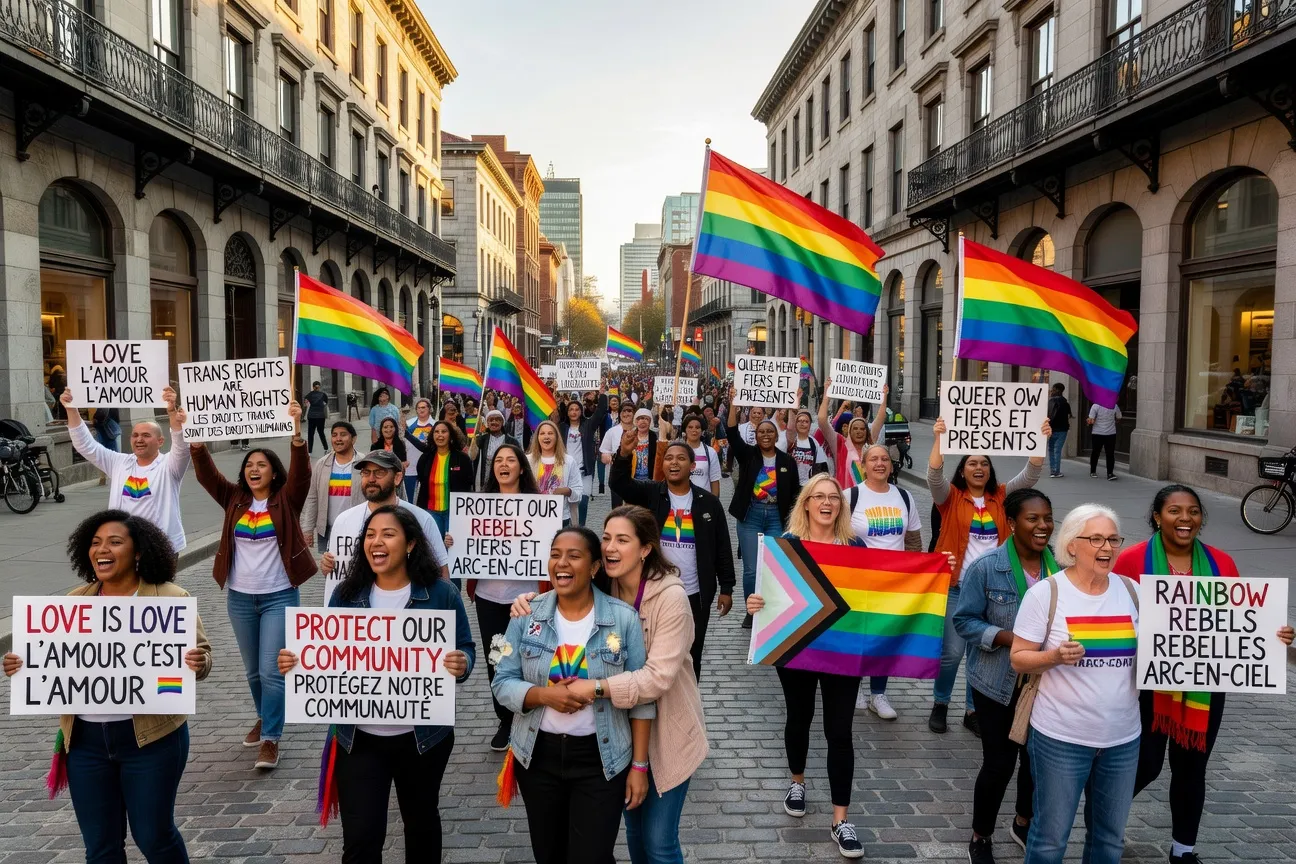
Why get involved for LGBTQ+ rights in Quebec in 2026?
In 2026, Quebec remains one of the most progressive jurisdictions in the world for LGBTQ+ rights. However, the gains achieved are never definitively secured. Hate speech online has exploded since 2020, homophobic and transphobic assaults have increased by 34% between 2018 and 2024 according to Statistics Canada, and several Canadian provinces have adopted restrictive legislation that raises concerns about a contagion effect.
In this context, civic engagement is not a luxury reserved for those with free time: it is an act of resistance, solidarity, and collective building. Engaging for LGBTQ+ rights in Quebec in 2026 means contributing to the protection of rights that took decades to be won, and to opening spaces of dignity for future generations.
The needs of organizations are immense and varied. It is not necessary to have the profile of a seasoned activist to contribute: skills in accounting, graphic design, IT, writing, or even simply being a supportive presence are just as valuable as the art of holding a megaphone during a demonstration.
According to the Volunteers Canada network, Quebec LGBTQ+ organizations rely on more than 8,000 active volunteers each year. But the needs expressed by these organizations for 2026 far exceed this number. Mobilization has never been more urgent and accessible.
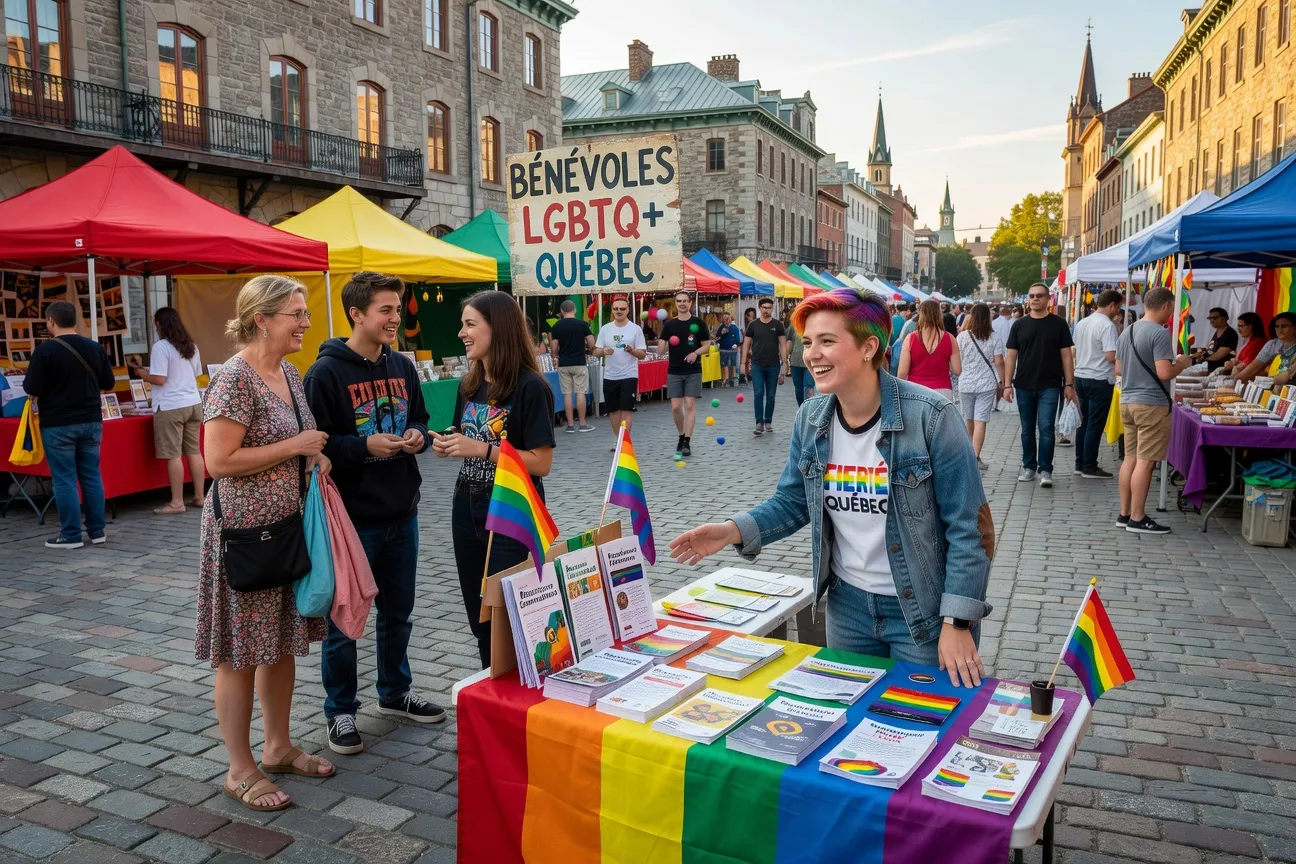
LGBTQ+ Volunteering: Find an Organization Near You
The first step to getting involved is to find an organization whose mission aligns with your values and availability. In Quebec, the LGBTQ+ community is rich and diverse, with organizations present in all regions, from Greater Montreal to Gaspésie.
In Montreal, the Montreal LGBTQ+ Community Centre (ccglbtq.qc.ca) is constantly recruiting volunteers for welcoming, facilitating support groups, event logistics, and digital communication. RÉZO, specializing in the health and well-being of gay and bisexual men, also offers volunteer opportunities in risk reduction programs.
In Quebec City, the Alliance Arc-en-Ciel de Québec and the Community Resource and Action Centre of Basse-Ville welcome volunteers for their shifts, support for at-risk youth, and local political actions.
In the regions, organizations like GRIS-Montérégie, GRIS-Outaouais, GRIS-Saguenay-Lac-Saint-Jean, and the Estrie Zone regularly seek willing witnesses to speak in high schools. These interventions last 90 minutes and involve sharing personal experiences in front of students — an act with immeasurable impact on LGBTQ+ youth in school settings.
How to find an organization? The platform Soleica offers support and civic engagement services in Quebec to guide individuals wishing to contribute to their community. Meanwhile, the national directory of Bénévoles Canada (benevoles.ca) allows filtering by region and theme.
Before applying, assess your actual availability: a commitment of 2 to 3 hours per week is often sufficient to make a tangible impact and to honor your commitment over time. For a broader overview of organizations by region and by cause, consult the complete directory of LGBTQ+ associations in Quebec, sorted by region and youth groups.
Join the CGLQ: missions, working groups, ways to contribute
The Coalition gaie et lesbienne du Québec (CGLQ), founded in 1992 and accredited by the United Nations Economic and Social Council (ECOSOC), is the main political representation organization for LGBTQ+ individuals in Quebec. Joining the CGLQ means committing to a space for national and international advocacy.
The CGLQ is organized into thematic working groups open to members and volunteers:
- International Rights Group: monitoring UN resolutions, drafting alternative reports, participating in sessions of the Human Rights Council in Geneva (in person or remotely).
- Communication and Media Group: managing social media, drafting press releases, producing visual content for awareness campaigns.
- Youth Group: workshop programs in schools, coordination with LGBTQ+ youth groups from CEGEPs and universities.
- Events and Pride Group: organizing the CGLQ's participation in provincial parades, coordinating booths, recruiting event volunteers.
- Public Policy Group: drafting briefs for government consultations, monitoring provincial and federal legislation.
To join a working group, simply send an email to le formulaire de contact mentioning your interest and skills. No prior experience in activism is required: training is done on the job, in a spirit of peer mentoring.
The annual membership fee for the CGLQ is accessible (rate adjusted according to income), and member status grants the right to vote at the annual general meeting, including for the election of the board of directors.
Activism online: digital activism, petitions, social media
Digital activism has become an essential lever in the defense of LGBTQ+ rights. From home, with a phone or a computer, it is possible to have a real impact on political decisions and popular culture.
Online petitions can generate significant pressure on elected officials. In 2023, a petition launched by Quebec LGBTQ+ organizations against a discriminatory school directive gathered over 45,000 signatures in 72 hours, forcing the government to revise its position. Platforms like Avaaz, Change.org, and the official petition platform at the National Assembly (assnat.qc.ca) allow for the launching or signing of petitions with legislative reach.
On social media, a few best practices are essential for effective and responsible activism:
- Amplify the voices of those directly affected (trans, racialized, Indigenous, disabled individuals) rather than speaking on their behalf.
- Verify sources before sharing: misinformation spreads quickly and can harm the credibility of the cause.
- Use extension hashtags (#LGBTQrights, #PrideQC, #QuebecInclusive) to connect your posts to existing conversations.
- Report hateful content to platforms and the police when it constitutes hate crimes (easy form on the RCMP website).
Content creation is a form of activism that is often underestimated. Writing a blog post, creating an educational video on trans rights, designing an infographic on available resources in Quebec — these contents circulate, are shared, and contribute to changing perceptions well beyond your immediate network.
Finally, contacting your elected officials directly by email or phone remains one of the most effective forms of activism. A personal, well-reasoned, and polite email has much more impact than a petition on a member of parliament compared to the decisions of an international bureaucratic organization.
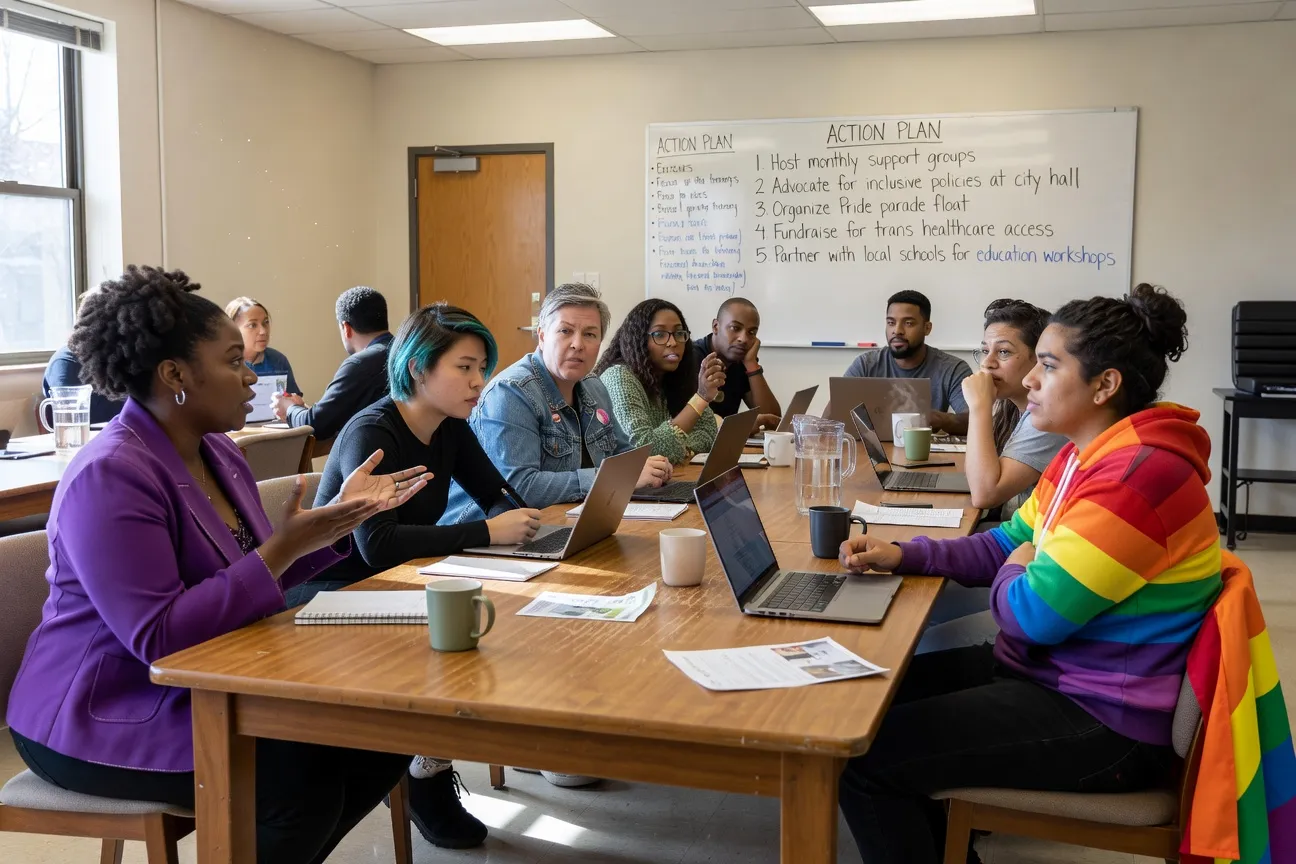
Getting involved in your school or university
Schools and universities are crucial spaces for LGBTQ+ visibility and safety. In 2026, several CEGEPs and universities in Quebec have active LGBTQ+ student associations, but their organizational health depends entirely on the mobilization of students.
Joining or creating an LGBTQ+ student group is often the most accessible form of engagement for young people. These groups organize awareness activities, themed meetings, cultural events, and representation actions with school administrations. In universities, they can also intervene in governance bodies (boards of directors, committees) to advocate for inclusive policies.
Rainbow alliances (also called GSAs, or Gender and Sexuality Alliances) in high schools are spaces of solidarity for LGBTQ+ youth and their allies. Some CEGEPs and universities have their own alliances, recognized by student associations. If your institution does not have one, the GRIS-Quebec network can assist you in the creation process.
Acting in your school environment also means calling on administrations regarding institutional policies: chosen pronouns in administrative files, staff training on trans and non-binary realities, access to gender-neutral bathrooms, anti-homophobic harassment protocols. These requests, made collectively, have significant chances of success.
Teachers and education professionals can also get involved by taking training on LGBTQ+ realities in the school context, offered notably by Egale Canada Education and the Quebec School Sports Development Council.
Share your testimony: public coming out and advocacy
Personal testimony is one of the most powerful forms of activism. When an LGBTQ+ person shares their experience — with its nuances, difficulties, and victories — they break stereotypes, humanize abstract issues, and give young people going through similar situations the assurance that they are not alone.
Testimony workshops organized by the GRIS (Groupe de recherche et d'intervention sociale) allow individuals to speak in secondary and college classrooms. After a one-day training, volunteer witnesses share their life journeys in front of groups of students, answer their questions, and help reduce homophobia and transphobia in schools. The impact is measurable: a study from UQAM (2022) shows that GRIS workshops reduce homophobic behaviors by 40% in the classes where they take place.
For those who prefer political advocacy, testifying before a parliamentary committee or participating in public consultations is a direct way to influence legislation. The Commission des droits de la personne et des droits de la jeunesse (CDPDJ), the Parliamentary Commission on Institutions, and municipal committees regularly receive briefs and presentations from organizations and ordinary citizens.
It is important to remember that no one is obligated to come out publicly. Activism takes many forms, and protecting one's privacy, job security, and family relationships is always a legitimate priority. Effective activism can be done anonymously or under a pseudonym, especially online.
Provincial committees and coalitions: sit and influence
Beyond grassroots volunteering, there are more structured forms of engagement that allow for influencing public policy at the provincial level. These spaces are generally open to experienced activists, but also to newly engaged individuals who wish to learn the ins and outs of institutional advocacy.
The Conseil québécois LGBT (cqlgbt.ca) brings together about thirty member organizations and coordinates representation actions with the provincial government. Its strategic orientation committee regularly seeks new members for two-year mandates.
The National Table for the Fight Against Homophobia and Transphobia in Education brings together representatives from the school environment, community organizations, and government bodies. Serving on this table allows for direct influence on provincial educational policies regarding LGBTQ+ inclusion.
At the federal level, several organizations participate in consultations with the Department of Justice and Canadian Heritage on minority rights issues. The CGLQ participates in some of these consultations as an accredited ECOSOC organization; its members can get involved in preparing the files.
Serving in these structures requires time and rigor, but offers an unparalleled satisfaction: seeing a recommendation you helped formulate appear in a bill is an experience that profoundly transforms one's relationship with citizenship — a process our interview with a historical figure on 50 years of LGBTQ+ activism in Quebec traces from its earliest grassroots forms to today's institutional advocacy.
Intersectional activism: LGBTQ+ and Indigenous rights, anti-racism
Intersectionality is not an academic jargon reserved for university feminist circles: it is a reality lived daily by thousands of Quebecers who hold multiple marginalized identities. A Black trans person, a bisexual Indigenous man, a racialized lesbian woman — these individuals face discriminations that cannot be reduced to one or the other of their identities, but result from the interaction of several simultaneous systems of oppression.
An LGBTQ+ activism that ignores these realities would not only be incomplete but also complicit in the invisibilization of those who need it most. Two-Spirit Indigenous communities in Quebec, for example, carry a conception of gender diversity rooted in their cultures and cosmologies, long before the arrival of European settlers — a perspective that enriches and challenges our usual categories.
Concretely, intersectional activism translates into:
- Including Indigenous, racialized, and trans voices in the decision-making of LGBTQ+ organizations (not just as targets of programs, but as leaders).
- Financially and politically supporting LGBTQ+ organizations led by specific communities (e.g., AGIR, for racialized queer individuals in Montreal).
- Continuously educating oneself about colonial histories, systemic violence, and the resistances of marginalized communities.
- Questioning one’s own privileges within the LGBTQ+ community and actively working to reduce internal power dynamics.
Alliances between movements — LGBTQ+, anti-racist, feminist, Indigenous — are a source of collective strength. Several coalitions in Montreal, including the Coalition féministe pour un avenir commun, have been practicing this active solidarity for years with tangible results.
Taking Care of Yourself While Activism: Preventing Activist Burnout
Activist engagement is emotionally demanding. Being in constant contact with stories of discrimination, violence, and injustice, while often carrying a marginalized identity oneself, exposes activists to a real risk of burnout — what social studies researchers call activist burnout or compassion fatigue.
Some warning signs to watch for: loss of motivation, growing cynicism towards the cause or colleagues, feelings of inefficacy, sleep disturbances, irritability. These symptoms do not mean you are a bad person or a poor activist: they signal that your capacity to give has been temporarily exceeded by your emotional expenditures.
Prevention strategies:
- Set clear boundaries with your commitments: do not respond to activist messages after 10 PM, reserve one evening a week without activism, say no to new mandates when your load is already full.
- Celebrate small victories: a legislative process can take years. Learning to recognize intermediate progress prevents the feeling of never moving forward.
- Build decompression spaces within your activist group: plan informal time (meals, outings, humor) to strengthen human connections beyond the mission.
- Seek psychological support if necessary. Organizations like AlterHéros or the LGBTQ+ Community Health Centre offer listening services tailored to activists.
Let’s remember the fundamental rule of the oxygen mask on airplanes: put yours on first before helping others. A healthy activist is a hundred times more effective than a burned-out activist. For a deeper look at minority stress and the support resources available to LGBTQ+ activists, see this guide on LGBTQ+ mental health in Quebec, minority stress, and support resources.
Resources and training for emerging activists
Training is a militant act. Better understanding legal issues, political dynamics, communication tools, and the principles of collective action makes each activist more effective and more resilient.
Here are some key resources available in 2026:
Free or low-cost online training:
- École de la démocratie (institutdemocracie.ca): training on advocacy, participatory democracy, and political communication adapted to the Quebec context.
- GRIS-Montréal: training days for future volunteer witnesses in schools (one-day workshops, free).
- Égale Canada: educational resources and training modules on LGBTQ+ rights in Canada for professionals and activists.
- Coalition féministe pour un avenir commun: workshops on intersectionality and inclusive activism.
Reference books and podcasts:
- Queer Nation by Émile Pelletier (2024) — history of the Quebec LGBTQ+ movement since the 1970s.
- Podcast La rue vers le futur — interviews with Quebec LGBTQ+ activists about their journeys and strategies.
- How to Be an Antiracist by Ibram X. Kendi — essential for any activist wishing to ground their commitment in an intersectional perspective.
Finally, the best training remains direct action: participating in an organizing meeting, attending a public consultation, making a first intervention in a school setting with an experienced mentor. Learning through experience, accompanied by critical reflection, is the royal road to competent activism grounded in reality.
Frequently asked questions
How to get involved in the defense of LGBTQ+ rights in Quebec if you are not LGBTQ+ yourself?
Allied individuals (non-LGBTQ+) are welcome in the vast majority of organizations. The role of an ally is to support without taking up space, to amplify LGBTQ+ voices rather than speaking over them. Specific training on the role of an ally is offered by Égale Canada and some community centers.
How much time should be dedicated per week to be a volunteer?
Most organizations adapt to your availability. A commitment of 2 to 4 hours per week is often sufficient to contribute significantly. Some occasional tasks (helping with an event, school testimony) only require a few hours per month.
Is it possible to advocate anonymously to protect one's privacy?
Yes, absolutely. Many activists use an online pseudonym or choose forms of engagement that do not require revealing their identity (logistical volunteering, writing, translation, technical support). Personal safety is always a priority.
Are there LGBTQ+ activism opportunities in the remote regions of Quebec?
Yes. Organizations like GRIS-Saguenay, GRIS-Outaouais, Zone Estrie, and Alliance Arc-en-Ciel are present in the region. Remote volunteering (digital communication, writing, phone support) is also available for those who live far from major centers.
How to create an LGBTQ+ group in my school or workplace?
Start by identifying interested individuals (allies included), approach management with a formal request and a concrete activity plan. The GRIS-Montréal network offers a practical guide for creating rainbow alliances in the school environment. At work, unions can be valuable allies in recognizing the group.