LGBT Rights Canada vs the World: Interview with Me Olivier Gagnon, Human Rights Lawyer
In brief: Canada is among the most protective countries for LGBT rights in the world. But what about elsewhere? Lawyer Olivier Gagnon, a specialist in human rights and international LGBT law, makes the comparison: 64 countries still criminalize homosexuality, 11 punish it with death, and Canada receives hundreds of asylum applications each year for LGBT persecution. Interview.
Why this interview
Canada is among the world leaders in LGBT rights: same-sex marriage since 2005, full recognition of same-sex families, constitutional protection against discrimination, and the ability for trans individuals to change their official documents. However, this horizon of formal rights remains the exception on a global scale.
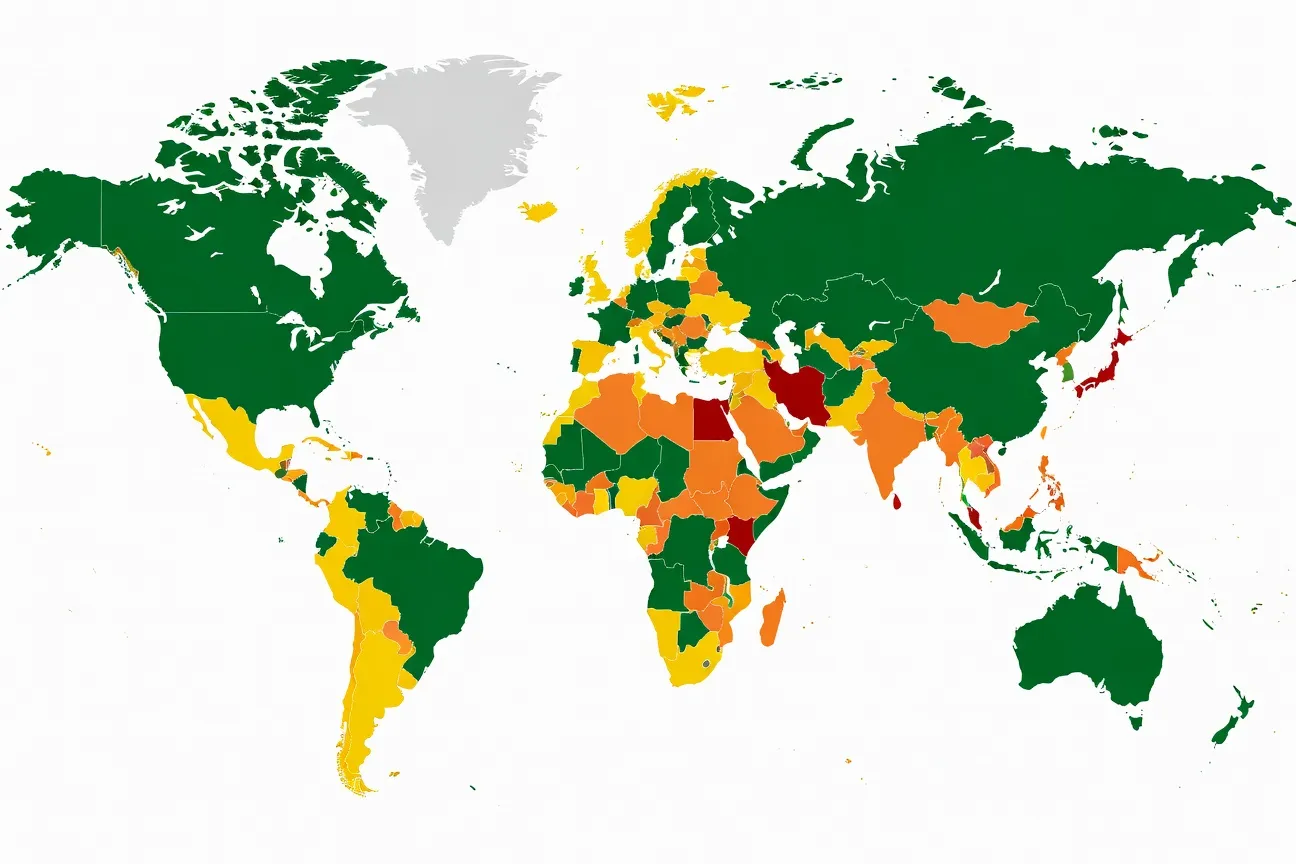
In 2026, according to ILGA World, 64 states still criminalize same-sex relationships. Eleven impose the death penalty, either in law or in practice. And several formerly progressive countries are experiencing a tangible regression in LGBT rights. To understand this gap, situate Canada in the global map, and discuss the role of international law, we spoke with Master Olivier Gagnon. The following interview summarizes the current legal state of international LGBT rights.
Editorial note: Master Olivier Gagnon is a composite character for this interview. He embodies the collective voice of legal experts specializing in LGBT human rights active in Canada.
The interview
Sophie : How would you position Canada in the global mapping of LGBT rights in 2026?
Olivier :Canada is among the twelve most protective countries in the world, alongside Belgium, the Netherlands, Norway, Sweden, Spain, Portugal, Malta, Denmark, New Zealand, Uruguay, and Argentina. Same-sex marriage is recognized, adoption is open, non-discrimination is enshrined in the Canadian Charter of Rights and Freedoms, and transgender individuals can change their gender designation without surgery.
Quebec has an additional particularity: its Charter of Human Rights and Freedoms, which has protected sexual orientation since 1977, is eight years prior to the Canadian Charter. It is the first jurisdiction in North America to have adopted this protection.
But it is important to nuance: while the legal framework is exemplary, discriminatory practices still exist. And above all, the situation can shift politically. The United States, for example, has started to roll back certain trans rights since 2024-2025. No country is safe from this.
Sophie : How many countries still criminalize homosexuality?
Olivier :According to ILGA-World, which publishes the global mapping each year, 64 states criminalize consensual sexual relations between adults of the same sex. This represents about one third of the member countries of the UN.
Of these 64 countries, 11 provide for the death penalty, either in law (Iran, Saudi Arabia, Yemen, Afghanistan under the Taliban regime since 2021, Sudan, Mauritania, certain regions of Nigeria and Somalia, United Arab Emirates according to a possible interpretation of Sharia), or in practice even without explicit law.
The other 53 countries provide for prison sentences ranging from a few months to life imprisonment. A large part of these laws are the legacy of 19th-century British colonial law, never repealed after independence. This is particularly the case in several countries in Africa, the Caribbean, and Asia.
Sophie : What is the role of international law in the defense of LGBT rights?
Olivier :International human rights law is progressing, but slowly. There is no specific international convention on LGBT rights, unlike what exists for women's rights (CEDAW) or children's rights (CRC). Advances are therefore mainly made through the interpretation of general conventions.
The International Covenant on Civil and Political Rights of 1966, for example, has been interpreted since 1994 by the Human Rights Committee as protecting sexual orientation (Toonen v. Australia). This UN jurisprudence, even if not directly binding, holds significant moral authority.
The UN Human Rights Council also adopted a historic resolution on human rights, sexual orientation, and gender identity in 2011. An Independent Expert on protection against violence and discrimination based on sexual orientation and gender identity was appointed in 2016. This is a structuring mandate for the UN on these issues.
Sophie : Canada welcomes asylum applications for LGBT persecution. How does this system work?
Olivier :Canada has recognized since 1991 that persecution based on sexual orientation or gender identity constitutes a valid ground for protection under the Geneva Convention on Refugees. It is the Pizarro Ward decision of the Immigration and Refugee Board that established this case law.
Concretely, several hundred people obtain asylum in Canada each year for this reason. The most represented countries of origin in 2025 were Nigeria, Iran, Russia, Uganda, Jamaica, and Iraq. The process remains complex: one must prove persecution, which often involves reliving trauma during the hearing.
Community organizations like AGIR (Action LGBTQ+ with Immigrants and Refugees) play an essential role in supporting these applications: preparation for hearings, gathering evidence of persecution in the country of origin, psychological support. Without these organizations, many applications would fail despite their legitimacy.
Sophie : What is the impact of the recent setbacks in the United States?
Olivier :Very significant, and it must be taken seriously. Since 2023-2024, several American states have adopted laws restricting access to gender-affirming care for trans individuals, particularly youth. The U.S. Supreme Court has also openly questioned certain gains in concurring opinions (notably on same-sex marriage, even though the Obergefell decision has not been overturned for the moment).
For Canada, the impact is threefold. On one hand, the increase in asylum requests from the United States: several hundred American trans individuals have sought asylum in Canada since 2024. On the other hand, the importation to Canada of anti-trans rhetoric constructed in the United States. Finally, the potential ripple effect on Canadian jurisprudence, even though our constitutional protections are stronger.
It is one of the cases where the vigilance of organizations like the CGLQ on an international scale is particularly important.
Sophie : Is marriage between same-sex individuals really the end point, or are there still legal battles to fight?
Olivier :Marriage is important symbolically and legally, but it is far from being the ultimate horizon. Many battles remain to be fought.
First, the full and complete recognition of trans families: a parent who transitions after the birth of their child must have their parenthood recognized without discrimination. Several Canadian jurisdictions do this, but not all.
Then, access to gender-affirming care: the right exists, but waitlists, regional inequality, and insufficient training of professionals are concrete obstacles to exercising that right.
Finally, the fight against violence. In Quebec as elsewhere in Canada, homophobic and transphobic assaults have increased in recent years. Criminal law provides for aggravating circumstances for hate crimes, but their application remains uneven.
Sophie : How do you explain that some African countries are recriminalizing homosexuality while the global trend is towards decriminalization?
Olivier :It is a complex phenomenon that cannot be reduced to a single cause. Uganda, for example, adopted an especially severe anti-homosexuality law in 2023, which provides for the death penalty for certain acts. Ghana, Burundi, and Nigeria are following similar trajectories.
Three converging factors: the British colonial legacy that enshrined criminalization in positive law in the 19th century; the influence of evangelical churches, primarily American, that have been exporting an anti-LGBT agenda since the 2000s; and the political instrumentalization of LGBT issues by regimes seeking to mobilize a conservative electoral base.
On the positive side, several countries have recently decriminalized: India in 2018, Angola in 2019, Botswana in 2019, Singapore in 2022, and the Cook Islands in 2023. The mapping is dynamic, not static.
Sophie : What role do Canadian LGBT NGOs play internationally?
Olivier :A significant role, even if it is often invisible to the eyes of the Canadian public. The CGLQ, for example, is one of the few French-speaking LGBT NGOs to have obtained consultative status with the UN ECOSOC, achieved in 2007. This allows it to participate in the work of the Human Rights Council in Geneva, to submit reports, and to speak in UN forums.
Egale Canada is involved in international legal matters and publishes comparative reports that reference them. Several Canadian lawyers sit on international committees or act as amicus curiae in cases abroad.
Canada itself, as a state, is active in the Equal Rights Coalition of over 40 countries. Global Affairs Canada funds programs to protect LGBT defenders abroad, particularly in countries where they are threatened.
Sophie : What advice would you give to a Canadian LGBT person who wants to get involved in international LGBT rights?
Olivier :First, support Canadian organizations active internationally, such as CGLQ, Egale Canada, or Rainbow Railroad. Financial donations or volunteering are the most direct levers.
Secondly, to educate oneself. International LGBT issues are complex, and one of the main mistakes to avoid is imposing a Western model that ignores local realities. LGBT activists in Africa, Asia, or the Middle East have developed their own strategies, which must be respected and supported, not replaced.
Thirdly, to inform oneself about asylum cases in Canada. LGBT individuals who have fled persecuting countries need concrete support upon their arrival: housing, assistance, integration. Organizations like AGIR, in Montreal, are always in need of volunteers.
Sophie : A general message on LGBT rights worldwide?
Olivier :The historical trajectory is towards the expansion of rights, over a span of several decades. In 1990, the WHO removed homosexuality from the list of mental illnesses. In 2001, the Netherlands legalized marriage. In 2018, India decriminalized. In 2025, more than 35 countries recognize same-sex marriage.
But this trajectory is neither linear nor irreversible. Each generation must commit to defending it. Quebec and Canada benefit from exceptional gains that must be protected while also serving as a model for regions of the world still in struggle.
It is this balance between pride in progress and international solidarity that defines, I believe, what it means to be an LGBT Canadian and Quebecker in 2026.
Quick questions: common misconceptions
Conclusion: 3 key takeaways
- Canada ranks among the top 12 countries in the world for protecting LGBT rights, but this position is recent (marriage in 2005) and remains political: no country is immune to a setback.
- Globally, 64 countries still criminalize same-sex relationships and 11 impose the death penalty. The mapping is dynamic: some countries decriminalize (India 2018, Singapore 2022) while others tighten laws (Uganda 2023).
- Canada receives hundreds of LGBT asylum applications each year. Supporting Canadian NGOs active internationally (CGLQ, Egale, Rainbow Railroad) and organizations that assist LGBT refugees (AGIR) is the most concrete commitment.
Frequently asked questions
How many countries still criminalize homosexuality in 2026?
According to ILGA World, 64 countries criminalize same-sex relationships in 2026, including 11 that impose the death penalty in law or in practice.
When did Canada legalize same-sex marriage?
Canada legalized same-sex marriage on July 20, 2005, becoming the fourth country in the world to do so at the national level, after the Netherlands (2001), Belgium (2003), and Spain (June 2005).
How to apply for asylum in Canada as a persecuted LGBT person?
You must submit an asylum application to the Immigration and Refugee Board, prove persecution in your country of origin, and your LGBT identity. Organizations like AGIR (Montreal) assist applicants in this process.
What is the CGLQ's consultative status at the UN?
The CGLQ obtained consultative status with the UN ECOSOC in 2007. This accreditation allows it to participate in the work of the Human Rights Council in Geneva, submit reports, and speak in UN forums.
What does international law say about LGBT rights?
There is no specific Convention. The protections arise from the interpretation of the 1966 International Covenants (Toonen jurisprudence 1994), resolutions of the Human Rights Council (since 2011), and the mandate of the Independent Expert on SOGI (since 2016).
What are the countries that have recently decriminalized homosexuality?
India in 2018, Angola in 2019, Botswana in 2019, Singapore in 2022, and the Cook Islands in 2023 are among the recent decriminalizations. The overall global trajectory remains the expansion of rights, despite specific setbacks (Uganda 2023, United States 2024-2025).
Does Quebec and Canada have different rules regarding LGBT rights?
Protections are now largely equivalent. Quebec was a forerunner with the Charter of Rights (1977), civil union (2002), and full and complete homoparentality (2002). The federal Canada followed with the legalization of marriage in 2005 and the constitutional protection of gender identity in 2017.