Lexicon of Pride 2026: 30 essential terms to understand the marches, flags, and queer culture
In brief: Pride, float, voguing, pinkwashing, Progress Pride, safer space… the vocabulary of Pride can seem confusing for those discovering it. This lexicon defines 30 key terms organized into eight categories: events and marches, flags and symbols, identities and orientations, political activism, pinkwashing and critique, ballroom culture, terminology of respect, and practical resources. Each definition is written in Quebec French, with the historical or community context essential for using these words accurately.
Why this Pride lexicon is essential in 2026
Why this Pride lexicon is essential in 2026
Every year, thousands of people participate for the first time in a Pride march in Quebec. They encounter flags they do not recognize, hear terms that are foreign to them, and wish to understand without being intrusive. This 2026 Pride lexicon addresses this need: 30 precise definitions, organized into categories, to navigate confidently through the universe of LGBTQ+ celebrations.
This glossary differs from the LGBTQ+ lexicon of 60 essential terms already available on this site: it specifically focuses on the vocabulary of events, flags, and Pride culture, rather than on identities and orientations in general. The selected terms reflect common usage during the 2025-2026 marches in Canada and France.
Each definition includes the origin of the term, its common usage, and, where applicable, the nuances to be respected. The vocabulary of Pride evolves quickly: some words originate in the Black and Latin community, while others come from Anglo-Saxon activism before being translated into French. Knowing them is to honor their history.
Also consult the 2026 LGBTQ+ World Days to place these terms within the activist calendar of the year.
Events and marches: Pride, parade, float, IDAHOT, Pride Month
Events and Marches: Pride, Parade, Float, IDAHOT, Pride Month
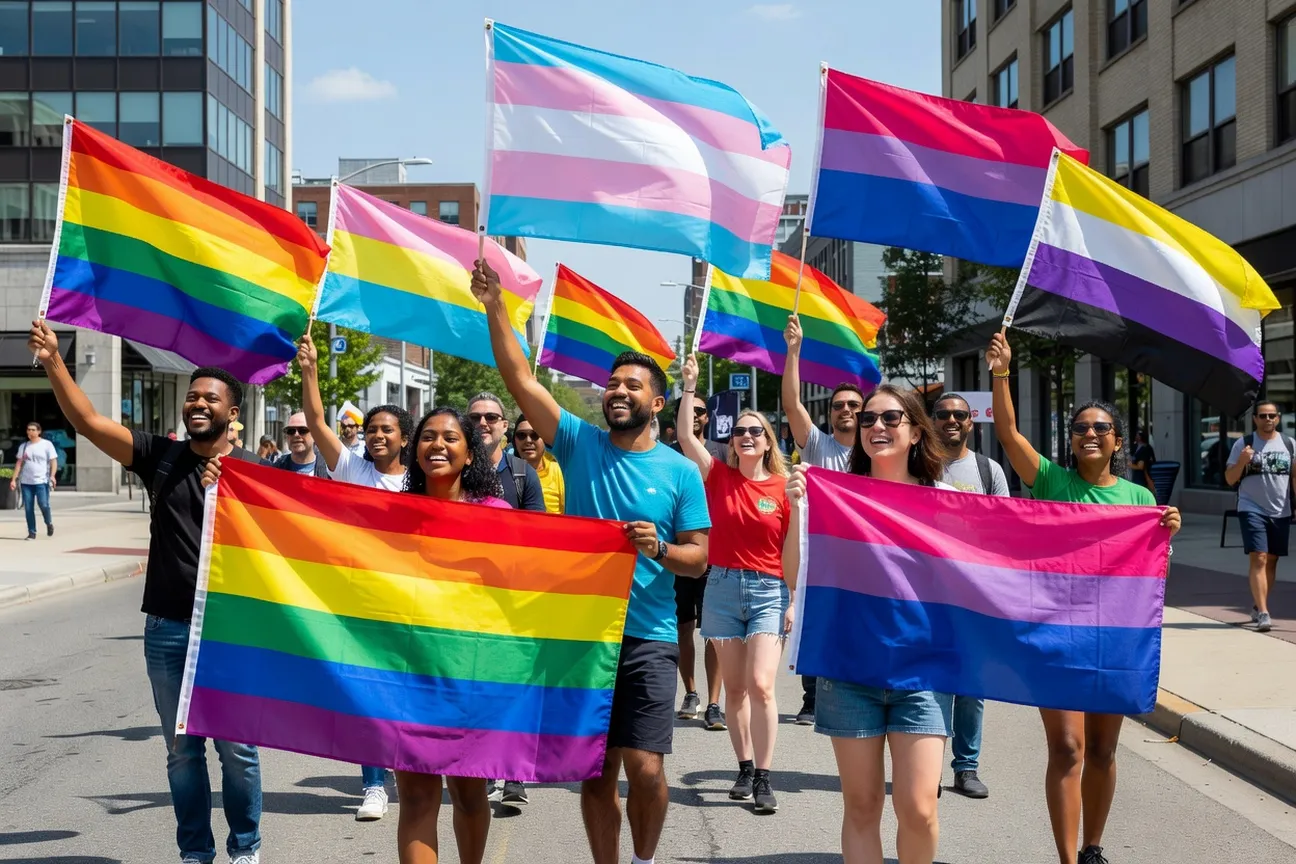
Pride — From the English word meaning « pride », this term refers both to the state of mind claimed by the LGBTQ+ community and the festive and militant event that celebrates it. Pride is a political act born in 1969 after the Stonewall riots in New York, when transgender, gay, and lesbian individuals resisted police raids. In Quebec, « Fierté » is often used in French, or both terms interchangeably. Participating in a Pride event is to affirm that the existence of LGBTQ+ individuals deserves to be celebrated publicly, without shame and without excuse.
March and Parade — The Pride march (or parade) is the highlight of the celebrations: a procession that moves through the streets of a city, gathering floats, associations, individuals, and families. The word « march » emphasizes the political dimension inherited from civil rights demonstrations, while « parade » is more festive. Both coexist in the official communications of major Quebec Pride events. Some cities organize both a political march and a spectacular parade on the same weekend, to respond to different sensitivities within the community.
Float — Borrowed from English, the term refers to a float, generally mounted on a vehicle, that participates in the Pride parade. Floats can be sponsored by businesses, associations, or community groups. The presence of corporate floats in marches is sometimes criticized (see « pinkwashing » below) when it is not accompanied by a real commitment outside of June. A community float, on the other hand, is carried by activist or cultural organizations rooted in the LGBTQ+ community throughout the year.
IDAHOT (International Day Against Homophobia, Transphobia and Biphobia) — International Day Against Homophobia, Transphobia and Biphobia, celebrated on May 17. The date commemorates the removal of homosexuality from the list of mental disorders by the World Health Organization in 1990. IDAHOT is not a festive Pride event: it is a moment of remembrance and militant action, often marked by conferences, flag-raising ceremonies, and gatherings in front of city halls. Many Quebecers confuse IDAHOT with Pride: both are important, but their tone differs.
Pride Month — Pride Month corresponds to June in most countries in the northern hemisphere, in reference to the Stonewall riots (June 1969). During this month, cities illuminate buildings in rainbow colors, businesses launch inclusive campaigns, and LGBTQ+ organizations ramp up their activities. The concentration of events in June allows for maximum visibility, but it also raises debates: shouldn’t the fight for rights be visible all year round? Nevertheless, Pride Month remains an important lever for awareness on a global scale.
Flags and symbols : rainbow, Progress Pride, and community flags
Flags and Symbols: Rainbow, Progress Pride, and Community Flags
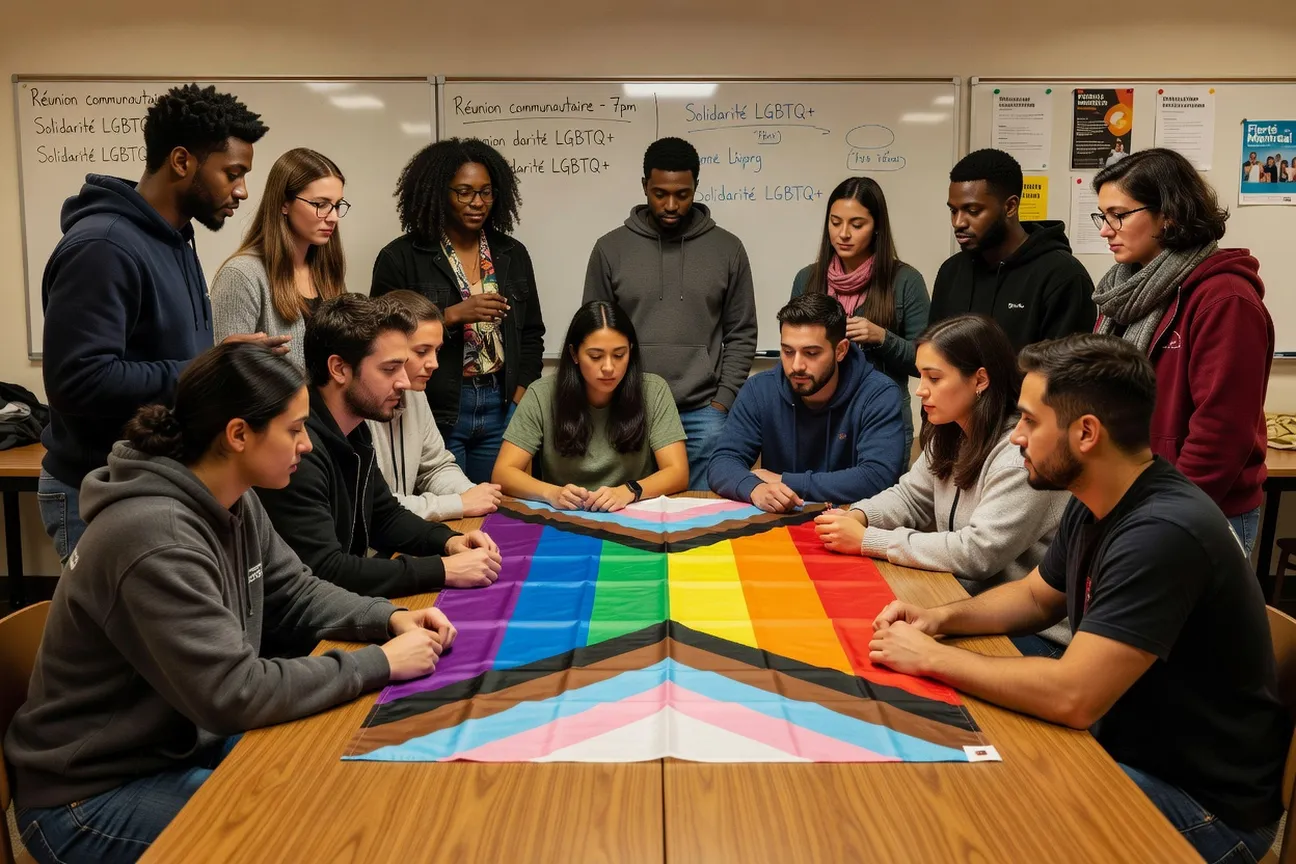
Rainbow Flag — Designed in 1978 by Gilbert Baker in San Francisco, the six-stripe rainbow flag (red, orange, yellow, green, blue, purple) is the most recognized symbol of LGBTQ+ Pride. Each color has an original meaning: life, healing, sunlight, nature, harmony, and spirit. The commercial version simplified the original model to eight stripes. This flag represents the entire LGBTQ+ community rather than a specific identity. It remains the most displayed flag during Pride marches around the world, even though many people today prefer the Progress Pride Flag for its greater visible inclusivity.
Progress Pride Flag — Created in 2018 by Daniel Quasar, this flag incorporates the six rainbow stripes and adds, in a chevron on the left side, stripes representing transgender people (white, pink, light blue), as well as black and brown individuals. The chevron design symbolizes the movement towards progress. The Progress Pride Flag has become the standard for Pride events that wish to explicitly display inclusion of racialized and transgender communities. Since 2021, an expanded version by Daniel Quasar also includes the intersex symbol (yellow and purple). Check out the guide to LGBTQ+ Pride flags for the complete history of each flag.
Trans Flag — Created in 1999 by Monica Helms, the transgender flag consists of two light blue stripes (for trans men), two pink stripes (for trans women), and a central white stripe (for non-binary, intersex, and questioning individuals). The symmetry of the flag is intentional: no matter which way it is held, it appears the same — a symbol of the affirmation and self-identity that transgender people seek in their lives. This flag is displayed by transgender individuals and their allies during Transgender Visibility Day (March 31) and Pride events.
Bisexual Flag — Designed in 1998 by Michael Page, this flag features three stripes: pink (attraction to the same gender), lavender (the overlap, symbolizing attraction to multiple genders), and blue (attraction to different genders). It addresses the need for visibility of bisexual individuals, who are often marginalized even within the LGBTQ+ community. This phenomenon of double discrimination (within the heterosexual community and within the gay or lesbian community) is known as biphobia. The bi flag remains one of the most displayed flags during marches, alongside the rainbow flag.
Non-Binary Flag — Created in 2014 by Kye Rowan, this four-stripe flag represents individuals whose gender does not fit into the male/female binary: yellow (non-binary gender), white (all genders), purple (a mix of feminine and masculine genders), and black (absence of gender or agender). Non-binary individuals exist in many cultures and have been recognized for centuries under various names (Two-Spirit among some Indigenous peoples, hijra in South Asia). Legal recognition of non-binary identities is slowly progressing in Quebec, notably through the inclusion of gender X on official documents.
Asexual Flag — Adopted in 2010 by the Asexual Visibility and Education Network (AVEN), this flag features four stripes: black (asexuality), gray (gray-asexuality and demisexuality), white (sexuality, to remind that sexual allies are part of the ace community), and purple (community). Asexuality refers to the absence or very low sexual attraction to others. It does not mean the absence of romantic capacity or desire for intimate relationships. The asexual community (referred to as "ace") is still underrepresented in Pride events and seeks to be more visible there.
Pansexual Flag — This pink, yellow, and cyan blue flag represents individuals who are sexually, romantically, or emotionally attracted to people of all genders, including non-binary individuals. Pink symbolizes attraction to women, blue to men, and yellow to all individuals outside the gender binary. Pansexuality is distinguished from bisexuality in common usage by this explicit inclusion of non-binary identities, although the two definitions overlap and many individuals identify with both terms.
Intersex Flag — Designed in 2013 by the Australian organization OII Australia, this yellow and purple flag is deliberately free of conventionally gender-associated codes. The circle represents integrity and wholeness. Intersex individuals are born with biological characteristics (chromosomal, gonadal, or anatomical) that do not fit typical medical definitions of male or female. Intersex variation is a biological reality, not a choice, and it does not determine a person's sexual orientation or gender identity.
Identities and orientations: queer, cisgender, non-binary, pansexual
Identities and orientations: queer, cisgender, non-binary, pansexual
Queer — Originally a derogatory term in English, reappropriated by the LGBTQ+ community in the 1980s-1990s. Today, « queer » serves both as an umbrella identity for people whose gender or orientation is not exclusively heterosexual or cisgender, and as a theoretical perspective (queer theory). In practice, a person may identify as « queer » because they resist fixed categories, or because no other term fits them better. It is important not to use this word to designate someone without their consent, as some older individuals still experience it as an insult.
Cisgender — Refers to a person whose gender identity corresponds to the sex assigned to them at birth. The Latin prefix « cis » means « on the same side », as opposed to « trans » (« on the other side »). This term allows for unambiguous discussion of non-trans individuals without labeling them with a supposed « normal ». It is not insulting: it is descriptive and neutral. Its use is common in LGBTQ+ spaces, universities, and activist circles.
Gender non-conforming (or GNC) — Refers to a person whose gender expression — way of dressing, behaving, presenting themselves — does not conform to the cultural norms associated with their assigned gender at birth. A gender non-conforming person may identify as male, female, non-binary, or otherwise: expression does not necessarily imply a trans identity. The term is often used by individuals who do not wish to or cannot fit into more specific categories, or who want to emphasize the social dimension of expression rather than internal identity.
Coming out — Refers to the moment when a person reveals to others (family, friends, colleagues) their sexual orientation or gender identity. Coming out is rarely a one-time event: an LGBTQ+ person often has to repeat this moment in each new relationship or situation. There is no « right way » to come out, nor an ideal moment: the safety of the person concerned takes precedence over everything. The National Coming Out Day is celebrated on October 11.
Allies, activism, and political vocabulary of Pride
Allyship, Activism, and Political Vocabulary of Pride
Ally — An ally is someone who is not LGBTQ+ but actively supports the rights and dignity of the community. Allyship goes beyond wearing the rainbow flag : it involves taking concrete actions — intervening against homophobia or transphobia, voting for inclusive policies, financially and publicly supporting LGBTQ+ organizations. A good ally makes space for LGBTQ+ voices rather than speaking over them, and accepts being corrected when they make a mistake. Allyship is an ongoing process, not a status that is achieved once and for all.
Safer space — A safer space is an environment where LGBTQ+ individuals can express themselves and be present without fear of discrimination, harassment, or violence. The term "safer" is used rather than "safe" because no space is perfectly safe for everyone : the term emphasizes intention and effort. Pride events, community centers, and certain cultural venues are often presented as safer spaces. They generally involve explicit rules (zero tolerance for hate speech) and trained individuals to intervene in case of an incident.
Activism — LGBTQ+ activism refers to the organized actions aimed at defending and expanding the rights of LGBTQ+ individuals. It takes many forms : protests, political lobbying, legal advocacy, community education, artistic and media creation. Pride activism is often seen as festive, but it is rooted in a history of hard struggles : the HIV crisis in the 1980s, the criminalization of homosexuality still in effect in 64 countries in 2026. Many activists emphasize that celebration and advocacy do not oppose each other, but rather complement one another.
Visibility — The concept of LGBTQ+ visibility refers to the public, media, and cultural presence of LGBTQ+ individuals. A visible person is someone who does not hide their identity or orientation in public spaces. Visibility is a powerful political tool : studies show that people with an LGBTQ+ loved one are less likely to hold homophobic prejudices. It also has a cost : being visible exposes individuals to risks of discrimination, even violence, depending on the context.
Intersectionality — A concept developed by legal scholar Kimberlé Crenshaw in 1989, intersectionality describes how multiple systems of oppression (racism, sexism, homophobia, classism, ableism) intersect and amplify each other in the life of the same person. A Black, trans individual from a modest background does not simply experience three additive discriminations : they face a unique situation where these systems interact. Intersectionality has become a central tool in inclusive Pride activism.
TERF (Trans-Exclusionary Radical Feminist) — An acronym designating certain feminists who exclude transgender women from their definition of feminism. This movement argues that gender is solely biological and that transgender women are not women. The vast majority of feminist and LGBTQ+ organizations reject this position as transphobic. The term is used critically, and those who reject it sometimes prefer the label "gender-critical feminists." In Pride, this debate leads to intense discussions about inclusion and the boundaries of sisterhood.
Gatekeeping — Gatekeeping refers to the act of questioning the legitimacy of an identity or community belonging by imposing arbitrary "authenticity" criteria. In Pride, this can take the form of individuals challenging the bisexual identity of others ("you've only had heterosexual relationships, you're not really bi") or trans identity ("you haven't had surgery, you're not really trans"). Gatekeeping is generally condemned within the LGBTQ+ community, which values self-determined identity.
Pinkwashing, rainbow washing and critical terms
Pinkwashing, rainbow washing and critical terms
Pinkwashing — Pinkwashing refers to the practice by an organization (business, government, state) of displaying superficial support for LGBTQ+ rights to conceal or compensate for otherwise harmful practices. The term was initially used in two contexts: the movement for the rights of people living with HIV/AIDS (derived from "greenwashing") and the criticism of the Israeli government, which presented its LGBT-friendly policy to obscure the situation of Palestinians. Today, the term also applies to companies that adorn their logo with a rainbow in June without concretely supporting their LGBTQ+ employees or contributing to the cause for the rest of the year. Pinkwashing is widely criticized in activist communities.
Rainbow washing — A variant of pinkwashing, rainbow washing specifically refers to the commercial use of rainbow symbols during Pride Month without substantial commitment. Brands display products in LGBTQ+ colors, often made in countries where homosexuality is criminalized, or without donating to organizations. Pride activists encourage questioning: has the company adopted inclusive HR policies? Does it financially support LGBTQ+ organizations? Does it speak out outside of June? This term invites critical consumption rather than systematic boycotting.
Ballroom culture, voguing, and terms from LGBTQ+ nightlife culture
Ballroom Culture, Voguing, and Terms from LGBTQ+ Nightlife Culture
Ballroom — Ballroom culture originated in New York in the 1970s-1980s within Black and Latino·a LGBTQ+ communities. It structures competitions (« balls ») where participants compete in various categories: fashion, dance, performance, « realness » (the ability to appear cisgender or heterosexual in public space). Ballroom culture has created its own social codes, its language (specific slang), and its family structure (the « houses »). It became globally famous thanks to the documentary « Paris Is Burning » (1990) and the series RuPaul’s Drag Race and Pose. It remains one of the most inventive and influential LGBTQ+ cultural expressions.
Voguing — A dance that originated in the balls of New York, voguing is characterized by poses inspired by the covers of Vogue magazine, angular arm movements, fluid transitions, and battles (« dips ») on the floor. Madonna popularized this dance in 1990, giving it global visibility but also sparking debates about cultural appropriation. Voguing continues to be practiced and evolved within ballroom communities, with several contemporary styles (Old Way, New Way, Vogue Femme). During Pride events, voguing battles take place in festive areas or on stage.
House — In ballroom culture, a « house » is a chosen family structured around a « mother » and/or a « father » who welcome and mentor young LGBTQ+ individuals often rejected by their biological families. Members of a house carry its name (House of Ninja, House of Xtravaganza, etc.) and compete together. This model of chosen family, born out of necessity, has become a recognized model of community support. Outside the ballroom scene, the term « chosen family » more broadly refers to the emotional networks that LGBTQ+ individuals build outside of their family of origin.
How to use this vocabulary with respect
How to Use This Vocabulary Respectfully
Mastering vocabulary is not enough : it must also be used wisely. The first rule is to follow the preferences of the person concerned. Someone who identifies as « queer » may prefer this term over « gay » or « lesbian ». Asking for pronouns is a basic sign of respect during Pride marches as well as in everyday life. Since Pride events are public, it is also recommended to ask for permission before photographing individuals in revealing attire or in a state of expression.
The second rule is not to appropriate the language of marginalized communities for humor or decoration. Many terms listed in this lexicon — voguing, queer, diva, throwing shade — originate from Black, Latina, and trans communities that created them in contexts of survival. Using them lightly without knowing their history can be hurtful. This list is a starting point, not a license.
The third rule : accept that you do not know everything and continue to learn. The vocabulary of Pride evolves every year. New terms emerge, others fall out of use or change meaning. The best way to stay up to date is to listen to community members, read LGBTQ+ media, and frequent inclusive spaces throughout the year — not just in June.
To extend your discovery, check out the Pride Montreal 2026 guide and explore the complete list of 60 essential LGBTQ+ terms to deepen your understanding of the community. For unions and equal marriage, the site photo-de-mariage.com offers detailed terminology on unions and equal marriage.
Frequently asked questions
What is the difference between the rainbow flag and the Progress Pride Flag?
The six-stripe rainbow flag has been the historical symbol of the LGBTQ+ community since 1978. The Progress Pride Flag (2018) adds stripes representing trans people and racialized communities. It is designed to display a more explicit inclusion. The two flags coexist during Pride events, with each person choosing the one that best aligns with their values and identity.
What is pinkwashing and how to detect it ?
Pinkwashing refers to the use of LGBTQ+ symbols for image purposes without concrete commitment. To detect it, ask yourself these questions: does the company financially support LGBTQ+ organizations? Does it have inclusive HR policies for its trans and non-binary employees? Does it speak out on LGBTQ+ rights outside of June? If the answers are negative, it is likely rainbow washing.
What is the origin of ballroom culture and voguing ?
Ballroom culture was born in the Black and Latino LGBTQ+ communities of New York in the 1970s. It provided a space for competition and recognition for individuals excluded even from the dominant Pride events. Voguing is a dance that originated within this culture, which became global after Madonna's music video in 1990 and the series Pose and RuPaul’s Drag Race.
What does « safer space » mean and how to create such a space ?
A safer space is an environment where LGBTQ+ individuals can express themselves without fearing discrimination or violence. To create one: establish explicit rules against hate speech, train individuals to intervene in case of an incident, use inclusive language, and allow people to withdraw if they feel uncomfortable. A safer space is never perfect, hence the term “safer” rather than “safe.”
What is the exact meaning of the term « queer » in 2026 ?
In 2026, « queer » functions both as an umbrella identity (for people whose gender or orientation are not exclusively cisgender and heterosexual) and as a critical perspective (queer theory). Some older individuals still experience it as a legacy insult: never use it to refer to someone without their consent.
Pourquoi dit-on « safer space » plutôt que « safe space »?
We prefer « safer » (more secure) to « safe » (secure) because no space can guarantee absolute safety for all individuals. The word « safer » emphasizes the intention and effort made rather than an impossible promise to keep. It also reminds us that creating an inclusive space is an ongoing process that requires vigilance and constant adjustments.
How does this lexicon differ from the general LGBTQ+ lexicon?
This glossary is centered on Pride: events (Pride, IDAHOT, ballroom), flags (Progress Pride, rainbow, trans, bisexuality) and political terms related to marches (pinkwashing, allyship, gatekeeping). The LGBTQ+ glossary of 60 essential terms covers a broader spectrum of identities, orientations, and community concepts not specifically related to celebrations.