Lesbians in Quebec: 2026 Guide to the Community, Places, and Associations
In brief: The lesbian community in Quebec brings together nearly 193,000 women in 2026, representing about one third of the LGBTQ+ community in Quebec. This guide presents a complete mapping of the lesbian community: statistics, history, community spaces, festivals, associations, regional life realities, specific health issues, and support resources. A reference for understanding the place of Quebec lesbians today.
How many lesbians in Quebec in 2026
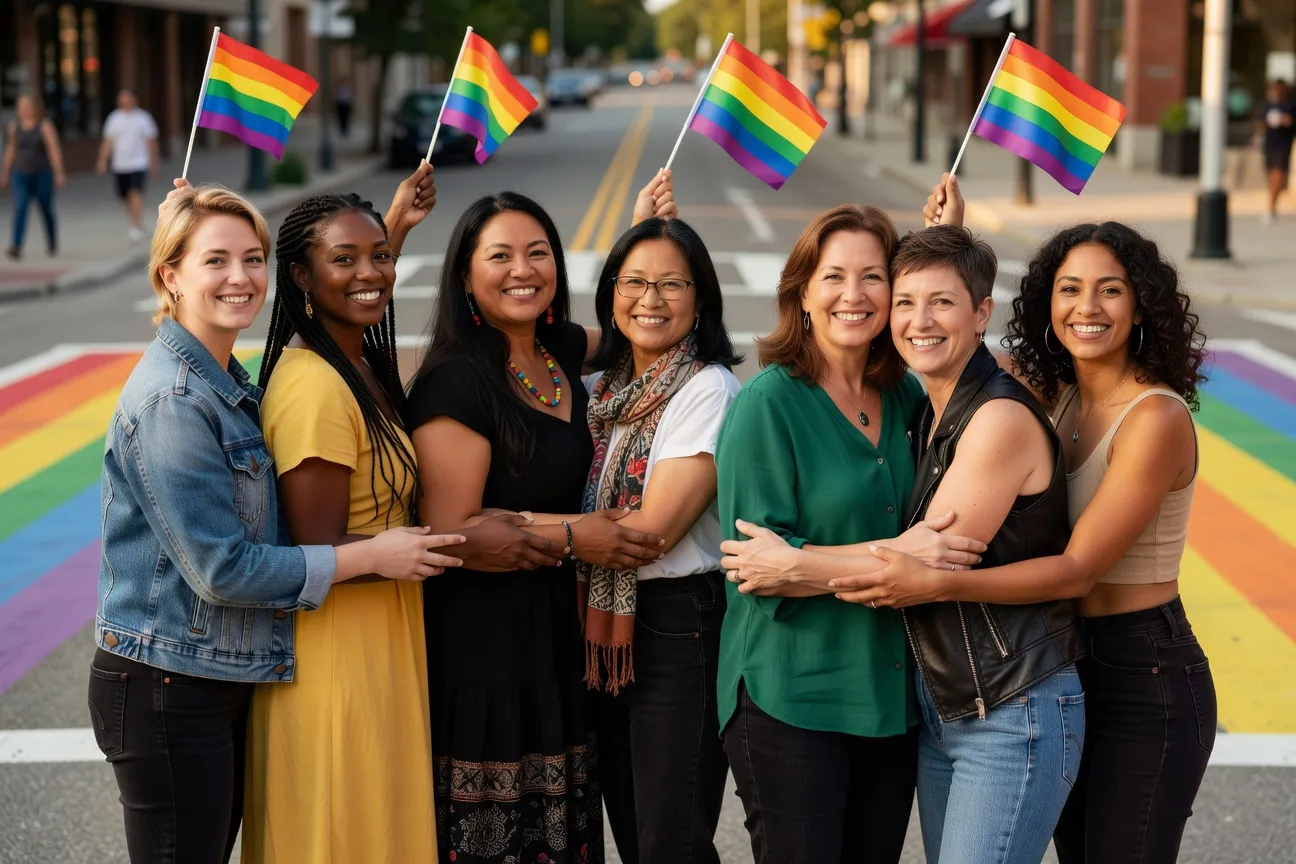
The Quebec lesbian community represents a substantial part of the province's population. Among the 600,000 LGBT people in Quebec recorded in 2026, lesbian women make up about 32%, or nearly 193,000 people. This proportion makes it the second largest demographic component of the LGBT community, after gay men (38%) and before bisexual (22%), trans (5%), and queer (3%) individuals.
Converging surveys from Statistics Canada, the Institut de la statistique du Québec, and the Chair in Research on Homophobia at UQAM establish that approximately 2.2% of Quebec women aged 15 and older identify as lesbians. This proportion rises to nearly 4% among women aged 15 to 24, reflecting the same trend of youth and increased visibility observed throughout the LGBT community.
The distinction between lesbians and bisexual women is demographically significant. Surveys show that bisexual women are significantly more numerous than lesbian women (about 3.5% of the female population compared to 2.2%). Both groups share some common concerns but develop partly distinct community spaces. This guide focuses on the lesbian community while also highlighting organizations that welcome bisexual women.
Geographically, the Quebec lesbian community is slightly less concentrated in Montreal than the gay male community. Nearly 57% of Quebec lesbians live in the greater metropolitan area of Montreal (compared to 64% of gay men), with a more pronounced presence in medium-sized cities (Sherbrooke, Trois-Rivières, Saguenay) and in several rural regions. This slightly different geographical distribution is partly explained by distinct residential trajectories, particularly related to parenthood.
History of the Quebec Lesbian Community (1970-2026)
The history of lesbians in Quebec is situated at the crossroads of the feminist movement and the homosexual movement. This dual affiliation has shaped the organizations, demands, and spaces of the lesbian community for five decades.
The 1970s: Feminism and Early Structuring
In the early 1970s, Quebec lesbians first organized within the emerging feminist movement. The creation of the Centre des femmes in Montreal (1972) and the opening of the café L'Androgýne in 1973 provided the first spaces where lesbians could gather outside of the male gaze. The same decade saw the founding of several autonomous lesbian collectives, including Lesbiennes en marche, which claimed a distinct political identity separate from both the gay movement (largely male) and heterosexual feminism.
The inclusion of sexual orientation in the Charte québécoise des droits et libertés in December 1977 marked a major legal turning point. This amendment, brought forth in a historical context described by the Quebec LGBT movement as foundational, theoretically protects lesbians against discrimination in employment, housing, and access to services. However, its effective implementation would require an additional two decades of mobilization.
The 1980s-1990s: Cultural Visibility and the Debate on Motherhood
The 1980s saw the emergence of a more visible Quebec lesbian culture. The creation of the publishing house Les éditions du remue-ménage allowed for the publication of several lesbian authors. The magazine Treize, followed by Amazones d'hier, lesbiennes d'aujourd'hui, structured a dedicated media space. Lesbian bars multiplied in the Village and on the Plateau, some of which, like the legendary Drugstore, would become sites of collective memory.
The issue of lesbian motherhood emerged in public debate at the end of the 1990s. Several hundred lesbian couples demanded recognition of their parenthood and access to medically assisted procreation. This mobilization led to the adoption in 2002 of the Act instituting civil union, which paved the way for full recognition of the homoparental family in Quebec, making the province one of the most advanced jurisdictions in the world on this issue.
The 2000s-2010: Legal Recognition and Institutionalization
The adoption of civil union in Quebec (2002) and the federal legalization of same-sex marriage in 2005 radically transformed the daily lives of lesbian couples. The founding of the Centre de solidarité lesbienne in 2002 and then the Réseau des lesbiennes du Québec (RLQ) in 1996 provided the lesbian community with enduring organizations specifically dedicated to its issues.
The 2015-2026: Intersectionality and New Challenges
The last decade has seen the emergence of intersectional issues raised by racialized lesbians, Indigenous lesbians (notably within two-spirit communities), and lesbians with disabilities. The conversation about the inclusion of trans women within lesbian spaces is also structuring, with the majority of Quebec organizations adopting an explicitly inclusive approach since 2018.
Iconic lesbian community spaces
Physical spaces play a central role in Quebec's lesbian sociability. While some historic places have disappeared (bars specifically for lesbians have become rare since 2010), an ecosystem of community centers, cafés, and occasional events now structures the life of the community.
The Lesbian Solidarity Centre
Founded in 2002 and located in Montreal, the Lesbian Solidarity Centre is the flagship organization of the Quebec lesbian community. It offers individual support, peer groups, social activities, training workshops, and a referral service to other resources. Its services are aimed at lesbian and bisexual women, as well as their loved ones. The Centre also publishes several specialized guides on lesbian health, domestic violence in a lesbian context, and parenting.
The Gay Village and Its Mixed Spaces
Montreal's Gay Village, although long perceived as a predominantly male space, includes several places frequented by the lesbian community. The café Cagibi on the Plateau-Mont-Royal, several feminist bookstores (including the legacy of the late L'Eugélionne), and the summer terraces of the pedestrian Village offer informal meeting points. Occasional lesbian nights organized in partner bars (Le Date, Notre Dame des Quilles, Levées de fonds Pride) maintain an active lesbian nightlife despite the scarcity of permanently dedicated spaces.
Lesbian Spaces Outside Montreal
In Quebec City, the LGBTQ2+ community center regularly hosts activities specific to lesbians (discussion groups, workshops, themed evenings). Sherbrooke has an active lesbian circle within Diversité Estrie, which has been organizing lesbian retreat weekends in the Eastern Townships since 2017. Trois-Rivières, Saguenay, and Gatineau have each developed local lesbian groups affiliated with regional LGBT community centers.
The Digital Turn: Apps and Social Networks
Since 2015, digital spaces have become an essential component of lesbian sociability, particularly in rural areas. Specialized dating apps (HER, Lex, Wapa) have an active base of Quebec users. Several closed Facebook groups, Discord servers, and thematic Instagram accounts (lesbian cooking, lesbian hiking, LGBT parenting) play a federating role. For couples or families preparing for a celebration, specialized resources like the guide to finding a photographer specializing in egalitarian weddings facilitate the preparation.

Lesbian Festivals and Events in Quebec
The calendar of specifically lesbian events in Quebec includes several annual structural meetings, organized by community organizations and cultural collectives.
The lesbian film festival
Several initiatives in lesbian cinema mark the Quebec calendar. The Image+Nation festival (Montreal, November), the oldest LGBT festival in Canada founded in 1987, programs a specific section dedicated to lesbian and feminist cinema each year. Several lesbian film clubs also exist in Montreal and Quebec City, screening films, documentaries, and short films from the international circuit.
Specifically lesbian Pride evenings
During Pride Montreal (first week of August), several evenings and activities are specifically designed for the lesbian community. The Lesbian Picnic at Lafontaine Park, the conferences hosted by the Quebec Lesbian Network, and the musical evenings organized by the Lesbian Solidarity Centre attract several thousand participants each year. Pride Quebec in September also offers a specific lesbian programming.
Literary and artistic festivals
The Feminist Book Fair in Montreal, as well as several reading cycles organized by feminist bookstores, provide visibility to Quebec and international lesbian authors. Lesbian visual arts find their place in galleries like Articule or the Centrale Galerie Powerhouse, which regularly host exhibitions from the lesbian scene.
Retreats and gatherings in the region
Lesbian retreat weekends are organized each year in the Eastern Townships, in the Laurentians, and in Mauricie. These events, of a more intimate scale (often around a hundred participants), allow lesbians from the regions to meet in a relaxed setting. The Camp Florence in the Laurentians and the lesbian writing residency organized in Estrie are pillars of the circuit. The complete calendar of LGBT prides 2026 references these events and their specific dates.
Associations and organizations specific to lesbians
The Quebec lesbian community relies on several dedicated national organizations and on lesbian groups integrated into broader LGBT organizations. This associative network is one of the most structured in French-speaking North America.
The Network of Lesbians of Quebec (RLQ)
Founded in 1996, the Network of Lesbians of Quebec is the national federating organization of the lesbian community. It brings together about thirty affiliated organizations, leads political advocacy with governments, and voices the specific demands of lesbians in public discussions on health, education, and rights. The RLQ publishes an annual report on the situation of lesbians in Quebec, a reference document for journalists, researchers, and decision-makers.
The Lesbian Solidarity Centre
The Lesbian Solidarity Centre, a frontline organization, offers listening, individual support, peer groups, and social activities. It welcomes lesbian and bisexual women, as well as their loved ones (parents, partners, children). Its programs include a support service for women in situations of lesbian domestic violence, a health component (with medical partnerships), and an integration program for migrant and refugee lesbians.
Transversal Lesbian Organizations
Several expanded LGBT organizations have active lesbian committees or specific programs:
- Coalition gaie et lesbienne du Quebec (CGLQ) — since its founding in 1992, the CGLQ has included lesbian representation on its board of directors and integrates lesbian issues into its ECOSOC-UN interventions.
- LGBT+ Families Coalition — majority of lesbian members among couples who have started a family in Quebec.
- Quebec LGBT Council — permanent lesbian committee that provides specific advice.
- Émergence Foundation — lesbian visibility programs for the International Day Against Homophobia and Lesbophobia (May 17).
Lesbian Organizations in the Regions
Several regions have local lesbian groups: Diversité Estrie (Sherbrooke), GRIS-Québec (Quebec City), LGBT Committee of Saguenay-Lac-Saint-Jean, Arc-en-ciel Côte-Nord. These groups organize social activities, discussion circles, and informal evenings. For a comprehensive mapping with contact details and services, consult the directory of LGBT associations in Quebec.
Living as a Lesbian in Quebec in 2026: Concrete Realities
Beyond the numbers and organizations, the daily life of lesbian Quebecers in 2026 is characterized by an undeniable degree of freedom, but also by specific realities that deserve to be named. Here are four major dimensions.
Couples and Celebrations
Lesbian couples in Quebec have benefited since 2005 from full legal recognition of same-sex marriage. More than 8,000 lesbian couples have married in Quebec between 2005 and 2026 according to civil status statistics. Civil unions, an option introduced in 2002, remain popular among part of the community. Lesbian ceremonies often incorporate personalized ritual elements, and a specialized professional sector (officiants, photographers, LGBT-friendly venues) has developed to support these celebrations.
Same-Sex Parent Families
Quebec is one of the most advanced jurisdictions in the world regarding the recognition of lesbian parenthood. Lesbian couples can access medically assisted procreation (MAP) with a sperm donor, adoption (both domestic and international), surrogacy in certain regulated contexts, and benefit from automatic recognition of both mothers in civil status. According to estimates from the Coalition des familles LGBT+, more than 4,500 lesbian families with children live in Quebec in 2026.
Professional Environment
The survey by the Fondation Émergence (2024) shows that 27% of lesbian Quebecers report having experienced discrimination or harassment at work due to their sexual orientation. This rate is slightly lower than that reported by gay men (35%), but remains significant. Issues specific to lesbians in the workplace include underrepresentation in leadership positions, sexist-lesbophobic jokes and remarks, and intrusive questions about motherhood. Resources on homophobia in the workplace address these issues.
Visibility and Coming Out
The average age of coming out for lesbians in Quebec is now 17.5 years, a constant decline over the past twenty years (it was 24 years in 2005). This precocity reflects increased normalization but also exposes young girls to potentially vulnerable periods within their families or school environments. Specialized resources (AlterHéros, GRIS) support young lesbian Quebecers in this stage.
Lesbians in region: isolation and networks
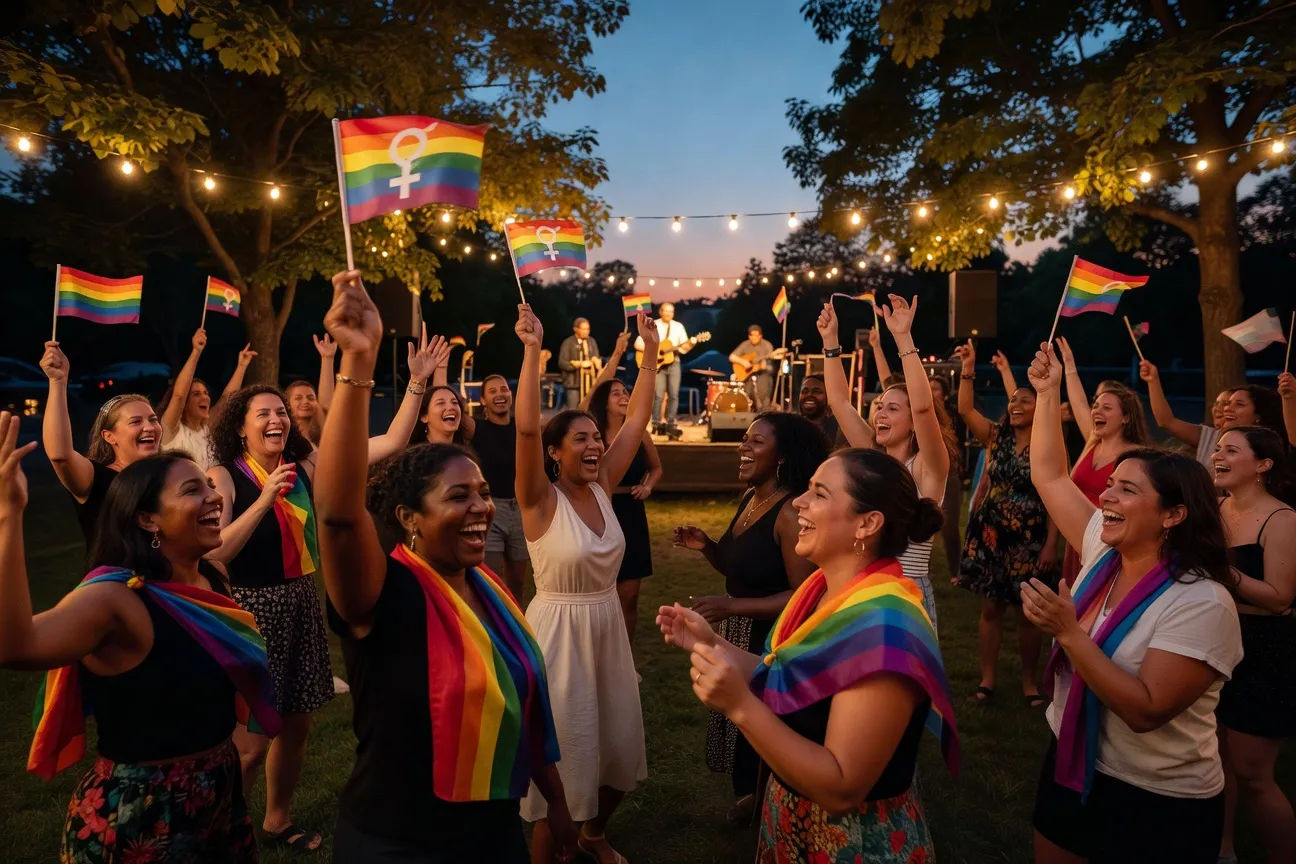
Nearly 43% of Quebec lesbians live outside the Greater Montreal metropolitan area. Their daily reality differs significantly from that of urban lesbians and deserves specific attention.
Social and geographical isolation remains the primary obstacle. In the least densely populated MRCs (Basse-Côte-Nord, Îles-de-la-Madeleine, Abitibi-Ouest), there are no lesbian bars, no specific organizations, and no regular peer groups. Lesbians often live their orientation in forced discretion for years. Surveys from the UQAM Chair in Homophobia Research show that 32% of lesbians in the region report having considered moving to Montreal or Quebec at least partially motivated by their sexual orientation.
The lack of cultural references and visible role models is a second obstacle. Regional media rarely address lesbian issues, school programs unevenly integrate sexual diversity, and workplaces offer few spaces to openly express one's orientation. Digital resources (Quebec Facebook groups, YouTube content, lesbian podcasts) have considerably alleviated this informational isolation since 2015, although they do not completely replace in-person contacts.
Lesbian couples in the region face specific challenges regarding access to care and services. Fertility centers specializing in assisted reproductive technology for same-sex couples are concentrated in Montreal and Quebec City, which means repeated travel over several months for women living in the region. Support services for LGBTQ+ families, LGBT-friendly pediatricians, and groups for young lesbian mothers are also rarer outside major centers.
Several regional initiatives deserve to be highlighted: the lesbian circle of Diversité Estrie (Sherbrooke) that organizes monthly activities, the lesbian group of the Saguenay-Lac-Saint-Jean LGBT Committee, the lesbian meetings in Outaouais coordinated from Gatineau, and the annual retreats in the Laurentians and Eastern Townships that regularly bring together lesbians from the five neighboring regions. These initiatives partially compensate for the absence of permanent spaces specifically for lesbians in the region.
Lesbian Health: Specific Issues in Quebec
Lesbians have specific health needs that remain unevenly recognized in the Quebec health system. Research from the Chair in Homophobia Research at UQAM and reports from the Network of Lesbians of Quebec identify several structural issues.
Reproductive and gynecological health
Lesbians have access to the same gynecological services as any woman in Quebec, but specific barriers persist. The heteronormativity of medical questionnaires (questions about contraception, about heterosexual relationships) regularly creates uncomfortable situations. Cervical cancer screening is statistically less frequent among lesbians (due to a mistaken perception of lower risk), while medical recommendations are the same. The Centre de solidarité lesbienne and the RLQ advocate for training health professionals on these issues.
Mental health and suicide risk
Quebec lesbians exhibit higher rates of anxiety and depressive disorders than the female average, particularly during coming-out periods and in response to experienced discrimination events. The suicide risk among young lesbians (15-24 years) is 3 to 5 times higher than that of their heterosexual peers. Several specialized resources support these issues: Interligne, AlterHéros, the Centre de solidarité lesbienne, and the resources for depression among young LGBT that provide concrete references.
Ageism and older lesbians
Older lesbians in Quebec, particularly those over 65, face specific challenges: invisibility in the media and historical narratives, increased social isolation in the event of widowhood, distrust of health services and residences for the elderly (often heteronormative), and the risk of returning to the closet in institutional settings. The Réseau Enchanté, an organization for LGBT seniors, and the RLQ have developed specific programs for older lesbians since 2018.
STIs and sexual health
The common perception that lesbian relationships are risk-free for the transmission of sexually transmitted and blood-borne infections (STIs) is partially incorrect. HPV, genital herpes, and certain bacteria (chlamydia, gonorrhea) can be transmitted during sexual practices between women. The RLQ and the Centre de solidarité lesbienne regularly disseminate information on the sexual health of lesbians, which is still too rarely addressed in school programs.
Lesbian visibility: cinema, literature, media
The cultural visibility of lesbians in Quebec has undergone remarkable evolution since the 1990s. While it has not reached the media visibility of gay men, Quebec's lesbian culture now has a consistent literary, cinematic, and journalistic ecosystem.
Quebec Lesbian Literature
Quebec lesbian literature has been structured since the 1970s with the editions of remue-ménage and several pioneering authors. Today, many Quebec lesbian authors regularly publish with major publishers (Boréal, Le Quartanier, La Peuplade) and address a variety of genres: novels, poetry, essays, autobiographies, comics. The Anne-Hébert Prize and several institutional literary awards have recognized numerous books written by lesbian authors or addressing lesbian themes since 2010.
Cinema and Visual Arts
Quebec lesbian cinema has developed over the past two decades. Several directors from the community have produced fiction films and documentaries exploring Quebec lesbian realities, winning awards at national and international festivals. The Image+Nation festival and several film clubs ensure the distribution of these works beyond festival circuits. Visual arts and performance also feature several recognized lesbian artists in the contemporary Quebec landscape.
Media Presence
The presence of lesbians in Quebec media has significantly increased since 2015. Several hosts, journalists, actresses, and public figures have come out and openly discuss their couple or homoparental family life. This visibility is unevenly distributed: more pronounced in general television and radio, it remains more discreet in sports, economic, and political spheres. The Conseil québécois LGBT and the RLQ advocate for an increase in airtime dedicated to lesbian issues.
Social Media and New Voices
Social media has allowed the emergence of new Quebec lesbian voices since 2018: podcasts (on culture, sexuality, lesbian parenting), editorialized Instagram accounts, YouTube channels, blogs. This diversity of formats and tones, primarily carried by independent creators, provides access to daily Quebec lesbian content, particularly appreciated by young lesbians in regions who do not have access to physical community spaces.
Help resources for lesbians in Quebec
Several free, confidential, and easily accessible resources are specifically aimed at lesbian Quebecers, their loved ones, and the professionals who support them. These resources complement the LGBT community centers that cover the entire territory of Quebec.
| Resource | Contact | Specialty |
|---|---|---|
| Centre de solidarité lesbienne | solidaritelesbienne.qc.ca | Listening, support, and activities for lesbians and bisexuals |
| Réseau des lesbiennes du Québec | rlq-qln.ca | National reference and political advocacy |
| Interligne | 1 888 505-1010 | LGBT listening service 24/7 (all orientations) |
| AlterHéros | alterheros.com | Young lesbians (13-30 years) |
| Coalition des familles LGBT+ | familleslgbt.org | Lesbian and homoparental families |
| SAVIE-LGBTQ | 1 855 410-0511 | Domestic violence in a lesbian context |
| Réseau Enchanté | reseauenchante.org | Older lesbians |
Specific resources in the region
For lesbians living in the region, the regional LGBT community centers serve as the main entry point: Diversité Estrie (Sherbrooke), GRIS-Québec (Quebec City), GRIS-Mauricie (Trois-Rivières), Comité LGBT du Saguenay-Lac-Saint-Jean, Pride Hudson in Ouest-de-l'Île, Arc-en-ciel Côte-Nord. Each offers activities specifically for lesbians (discussion circles, evenings, retreats).
Supporting the lesbian community
The Coalition gaie et lesbienne du Québec also welcomes lesbian and allied members. Becoming a member of the CGLQ allows for direct support of the political advocacy and international engagement carried out by the organization since 1992. Donations and memberships fund concrete activities and give weight to organizations in their dealings with public authorities.
Frequently asked questions
How many lesbians live in Quebec in 2026?
Approximately 193,000 women, or 32% of the LGBTQ+ community in Quebec and about 2.2% of the female population of the province aged 15 and older. This proportion rises to nearly 4% among young women aged 15 to 24.
What are the main organizations for lesbians in Quebec?
The two specific national organizations are the Centre de solidarité lesbienne (founded in 2002, direct support) and the Réseau des lesbiennes du Québec (founded in 1996, national advocacy). The CGLQ, the Coalition des familles LGBT+, the Conseil québécois LGBT, and the Fondation Émergence also address lesbian issues.
What lesbian dating apps are used in Quebec?
The most active apps in Quebec are HER, Lex, and Wapa, specifically designed for the lesbian and bisexual community. Several closed Quebec Facebook groups and Discord servers complement the digital dating ecosystem.
Are there lesbian bars in Montreal?
Les bars spécifiquement lesbiens permanents sont devenus rares depuis 2010, mais plusieurs établissements du Village gai et du Plateau accueillent régulièrement des soirées lesbiennes ponctuelles (Le Date, Notre Dame des Quilles). Le Pique-nique des lesbiennes au parc Lafontaine pendant Fierté Montréal rassemble des milliers de participantes chaque année.
How can lesbian couples start a family in Quebec?
Quebec offers one of the most advanced frameworks in the world: access to medically assisted procreation (MAP) with a donor, to domestic and international adoption, to surrogacy in certain regulated contexts, and automatic recognition of both mothers in the civil registry. The Coalition of LGBT+ Families supports over 4,500 lesbian families in Quebec in 2026.
What are the main health challenges specific to lesbians in Quebec?
Four issues shape lesbian health: the heteronormativity of gynecological consultations, the underestimation of cervical cancer screening, the suicide risk being 3 to 5 times higher among young lesbians, and the invisibility of older lesbians in institutional settings.
How to live as a lesbian in the regions of Quebec?
Nearly 43% of Quebec lesbians live in rural areas. Isolation remains a challenge, but networks exist: Diversité Estrie, GRIS-Québec, LGBT Committee of Saguenay-Lac-Saint-Jean, Arc-en-ciel Côte-Nord. Annual lesbian retreats in the Eastern Townships, the Laurentians, and Mauricie complement the offerings. Digital resources are essential for less densely populated areas.