LGBTQ+ travel in Quebec in 2026: where to go, when to go and where to stay
In short: Quebec is one of the world's top-rated destinations for LGBTQ+ travellers: Canada ranks 4th (tied) in the 2026 Spartacus Gay Travel Index, and Montreal's Gay Village — the largest of its kind in North America according to Bonjour Québec — offers a festive pedestrian street all summer. Between Fierté Montréal (July 31 to August 9, 2026, with over one million participations), Québec City's Fête Arc-en-ciel, Fierté Sherbrooke and Fierté Charlevoix, there is now an LGBTQ+ event in every season, in every region.
Why choose Quebec for an LGBTQ+ vacation
Canada holds an enviable position in international LGBTQ+ travel rankings. In the 2026 Spartacus Gay Travel Index, which ranks 217 countries by their rights, protections and social climate, Canada finishes 4th (tied) — it was 1st (tied) in the 2025 edition. This standing rests on a solid legal foundation: Quebec was the first Canadian province to ban discrimination based on sexual orientation in 1977, same-sex marriage has been legal across Canada since 2005, and conversion practices are federal criminal offences since 2022.
This framework translates concretely into the travel experience. In Montreal and Quebec City, same-sex couples move about freely, businesses display their openness, and recourse organizations are accessible in French. For a full overview of the legal framework, see our page on LGBTQ+ rights in Quebec: the essentials.
There is also a simple matter of supply. Few destinations in the world combine a French-speaking metropolis with the largest LGBTQ+ neighbourhood in North America, historic cities, and natural regions where regional Pride celebrations now animate the entire territory, four seasons of activities, and a safety level comparable to Western Europe.
Montreal and the Gay Village: the anchor of the trip
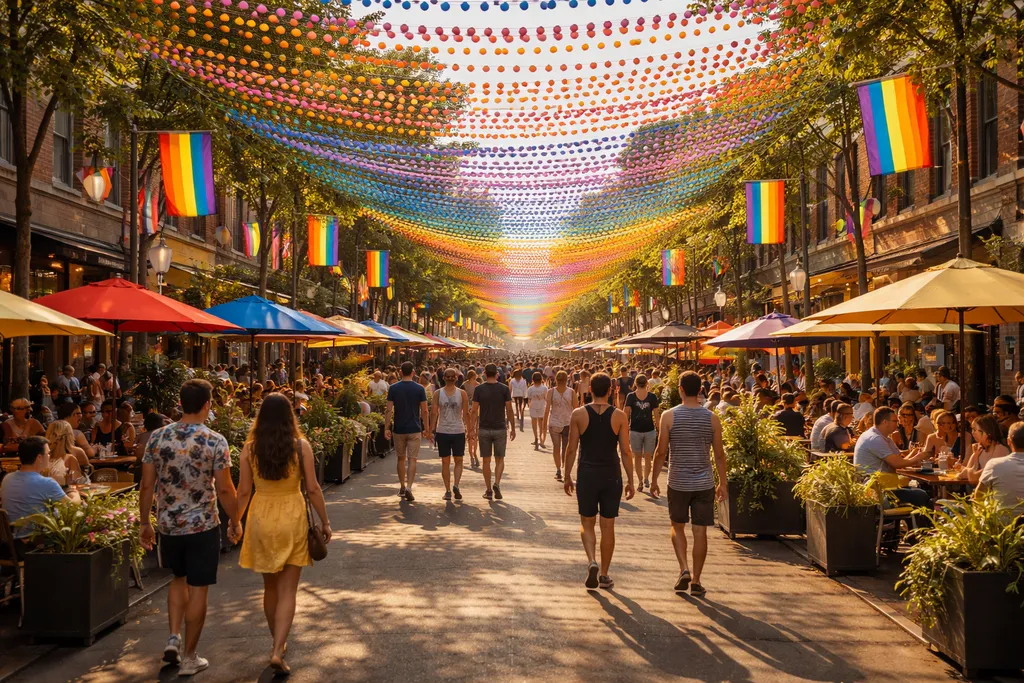
Located around Sainte-Catherine Street, between Berri and Papineau, the Gay Village is according to Bonjour Québec the largest of its kind in North America. Bars, restaurants, boutiques, antique shops and tourist lodgings rub shoulders in a festive atmosphere, and the street becomes pedestrian-only in the summer season. For its 20th anniversary, the pedestrian artery runs from Place Émilie-Gamelin, near Berri-UQAM metro station, to Papineau Avenue, and remains open until October 12, 2026.
The numbers of the summer season set the tone: more than 40 terraces line the street and its surroundings, the Village's "trouples" — benches made from recycled materials — provide 315 outdoor seats, and more than 200 greening spaces have been set up along the artery. West of the Village, the Jardins Gamelin offer a free daily program from May 28 to September 13: concerts, drag performances, karaoke and salsa lessons.
The district also carries a history that visitors can touch. At the corner of Panet and Sainte-Catherine streets, the Parc de l'Espoir was created on December 1, 1991 by ACT UP Montreal to commemorate lives lost to AIDS; inaugurated in 1997, it was redesigned by the City in 2021. This memory, combined with today's commercial vitality, makes the Village much more than a nightlife spot: it is a heritage site in its own right.
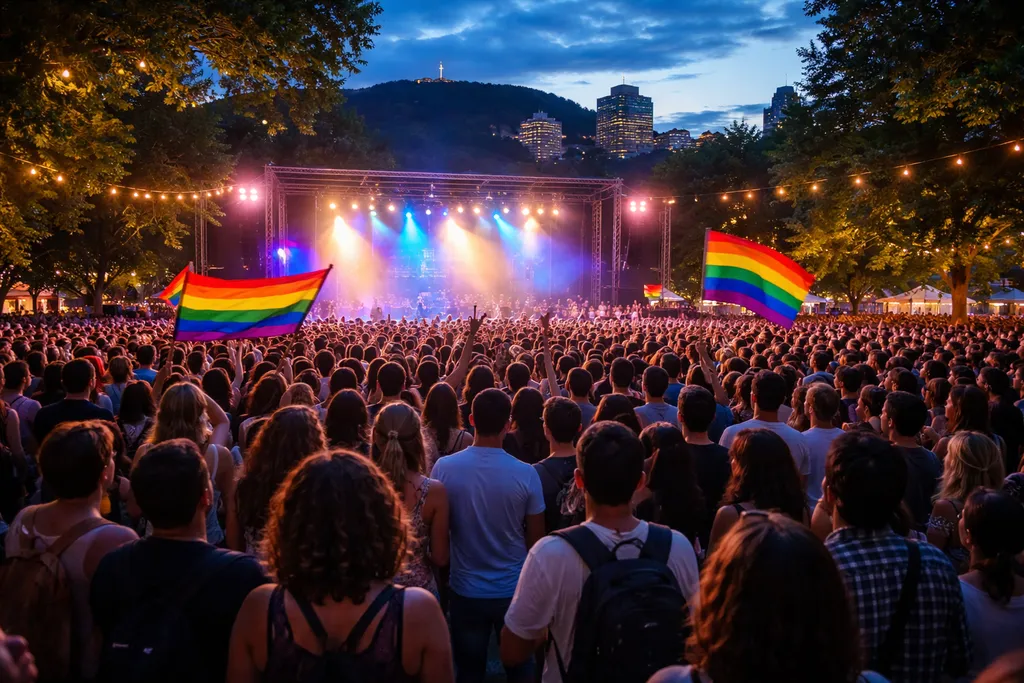
The great summer reunions remain the highlight, however. For the 20th edition of Fierté Montréal, held from July 31 to August 9, 2026, more than one million participations were counted across the ten days of activities, including nearly 20,000 marchers and over 200,000 spectators at the parade. To prepare for that week — accommodation, good viewing spots, safety — our complete guide to Fierté Montréal, the parade and the Village covers everything you need to know.
Beyond Montreal: Quebec City, Charlevoix, Sherbrooke
Montreal is not the whole story. In Quebec City, Bonjour Québec points to Saint-Jean Street, which concentrates much of the LGBTQ+ or rainbow-flagged retail, and the Fête Arc-en-ciel, a free socio-artistic festival animating downtown from August to September. In the Eastern Townships, Fierté Sherbrooke Pride celebrates diversity in September. In Charlevoix, Fierté Charlevoix runs in May from Baie-Saint-Paul to Saint-Siméon, blending agricultural Pride, theatre, visual arts and casino shows.
These regional events change the travel equation: it becomes possible to combine an urban getaway in Montreal with a regional stay without ever leaving the LGBTQ+ calendar. To choose your destination by date, see our guide to regional Prides — Gatineau, Sherbrooke, Saguenay and Trois-Rivières.
Between festivals, nightlife also exists outside the metropolis: community bars, themed parties and occasional events animate several regional cities, especially in summer. Our guide to LGBTQ+ bars, events and going-out spots outside Montreal lists the known addresses.
The calendar of major events
The Quebec LGBTQ+ tourist season is no longer concentrated on a single summer month: every season now has its signature event, making it possible to spread visits across the whole year.
- February — Massimadi, the Afro LGBTQ+ film and arts festival, takes place in Montreal during Black History Month.
- May — Fierté Charlevoix animates Baie-Saint-Paul and Saint-Siméon around terroir food, theatre and the arts.
- July — The MTL en Arts Festival presents the work of some 200 visual artists in the Village.
- Late July – early August — Fierté Montréal, the largest LGBTQ+ festival in the Francophonie, with its closing parade.
- August – September — The Fête Arc-en-ciel in Quebec City extends the summer with free shows and themed parties.
- September — Fierté Sherbrooke Pride celebrates diversity in the Eastern Townships.
- November — Image+Nation, Canada's first LGBTQ+ film festival (founded in 1987) and the second in North America.
The table below summarizes the best windows according to the type of trip you are looking for.
| Period | Signature event | Type of trip |
|---|---|---|
| February | Massimadi (Montreal) | Winter city break, cinema and arts |
| May | Fierté Charlevoix | Regional stay, gastronomy and landscapes |
| Summer (June – September) | Village pedestrian street, Jardins Gamelin | Neighbourhood life, terraces, beaches and festivals |
| July 31 – August 9, 2026 | Fierté Montréal | Major festival, parade, nightlife |
| August – September | Fête Arc-en-ciel (Quebec City), Fierté Sherbrooke | Heritage, nature and regional Prides |
| November | Image+Nation (Montreal) | LGBTQ+ cinema, mild off-season weather |
One useful clarification: while the Fierté Montréal period concentrates demand, the festival's attendance figures show that programming extends far beyond the Village — Community Days, the Rainbow Market and the big shows together drew more than 700,000 participations outside the parade. Booking accommodation several weeks ahead remains essential, but the experience is not limited to a single street.
Accommodation and budget: what to plan for
LGBTQ+ accommodation in Quebec is concentrated in Montreal: around Sainte-Catherine Street East, several inns and small character hotels serve a predominantly gay clientele, and the neighbouring Plateau-Mont-Royal or Mile End offer often cheaper alternatives a few minutes' walk away. In Quebec City and the regions there is no equivalent to the Village: you then choose standard accommodation downtown, taking comfort in the fact that the community is visible and allied businesses are clearly signalled.
On the budget side, there is no "LGBTQ+ rate": a Quebec trip costs broadly what a North American trip costs, with strong seasonality. Summer and Pride week push prices up in Montreal, while fall and spring offer better value everywhere else. To put concrete numbers on your stay (lodging, meals, transportation, tipping), the detailed budget guide for a trip to Quebec published by our partner voyage-quebec.com provides concrete benchmarks.
A tourism industry trained in LGBTQ+ welcoming
Quebec's positioning is no accident: it rests on visible institutional work. The Ministry of Tourism announced funding of $195,000 over two years to the UQAM Research Chair on Sexual Diversity and Gender Plurality to develop awareness tools on the realities and needs of LGBTQ+ clientele in tourism settings. These resources will be made available to regional and sectoral tourism associations and industry partners.
This measure is part of the Government Action Plan against Homophobia and Transphobia 2023-2028 and the Sustainable Tourism Growth Strategy 2025-2030, which explicitly targets a "more welcoming, inclusive and safe" destination. For travellers, the concrete effect is twofold: increasingly trained staff and increasingly reliable signage across the province.
Safety and common sense for travellers
Both in perception and in rights, Quebec is a low-risk destination for LGBTQ+ travellers. Montreal and Quebec City offer a particularly welcoming environment, regional Prides unfold without major incidents — the 2026 edition of Fierté Montréal was held "in a safe environment and without any major incidents," according to the organization — and positive media coverage sustains a real culture of hospitality in the tourism sector.
Common sense still applies, as everywhere: experiences can vary by region, rural settings, or trans and non-binary visibility, and international rankings measure averages, not every interaction. Keeping the contact details of recourse resources (the Commission des droits de la personne, helplines such as Interligne, regional organizations) at hand is enough in the vast majority of situations.
Frequently asked questions
What is the best time for an LGBTQ+ trip to Quebec?
It depends on the experience you want. For neighbourhood life and the Village terraces, the pedestrian artery period (late May to October 12, 2026) is ideal, peaking during Fierté Montréal, July 31 to August 9, 2026. For budgets, fall (Quebec City's Fête Arc-en-ciel, Fierté Sherbrooke) offers better prices. Winter suits film festival fans, with Massimadi in February and Image+Nation in November.
Is Quebec a safe destination for a same-sex couple?
Yes, overall. Canada ranks 4th (tied) in the 2026 Spartacus Gay Travel Index, equal marriage has been in force since 2005, and conversion practices have been banned since 2022. In Montreal and Quebec City, same-sex couples move about freely. As everywhere, experiences can vary in some rural settings or depending on trans or non-binary visibility; recourse organizations remain available if needed.
Where should I stay in Montreal's Gay Village?
Around Sainte-Catherine Street East, between Berri and Papineau, several inns and small character hotels welcome a predominantly LGBTQ+ clientele. For Pride week (late July – early August), book several weeks in advance: demand is strong. Plateau-Mont-Royal and Mile End, next to the Village, offer often cheaper alternatives a few minutes' walk away.
Are there LGBTQ+ events outside Montreal?
Yes, and their number keeps growing. The Fête Arc-en-ciel in Quebec City (August – September), Fierté Sherbrooke Pride (September) and Fierté Charlevoix (May, from Baie-Saint-Paul to Saint-Siméon) are the three most established regional events, according to Bonjour Québec. Image+Nation (November) and Massimadi (February), in Montreal, round out the cultural year.
Does an LGBTQ+ trip to Quebec cost more than a regular trip?
No. There is no specific pricing: cost depends only on season, city and accommodation type. Prices rise in Montreal during summer and Pride week, and drop noticeably in fall and spring. Add a budget for transportation, meals and tipping, as for any stay in Canada.