LGBT+ Rights Around the World: CGLQ on the International Stage
In brief: Since 2007, CGLQ has held consultative status with the United Nations ECOSOC, making it the only Quebec LGBT NGO accredited by the UN. This article provides an overview of the state of LGBT+ rights around the world in 2026, region by region, and details CGLQ's concrete role in defending these rights internationally. From Quebec, recognized as a model of equality, to countries where homosexuality remains punishable by death, the reality of LGBT+ people remains profoundly unequal.
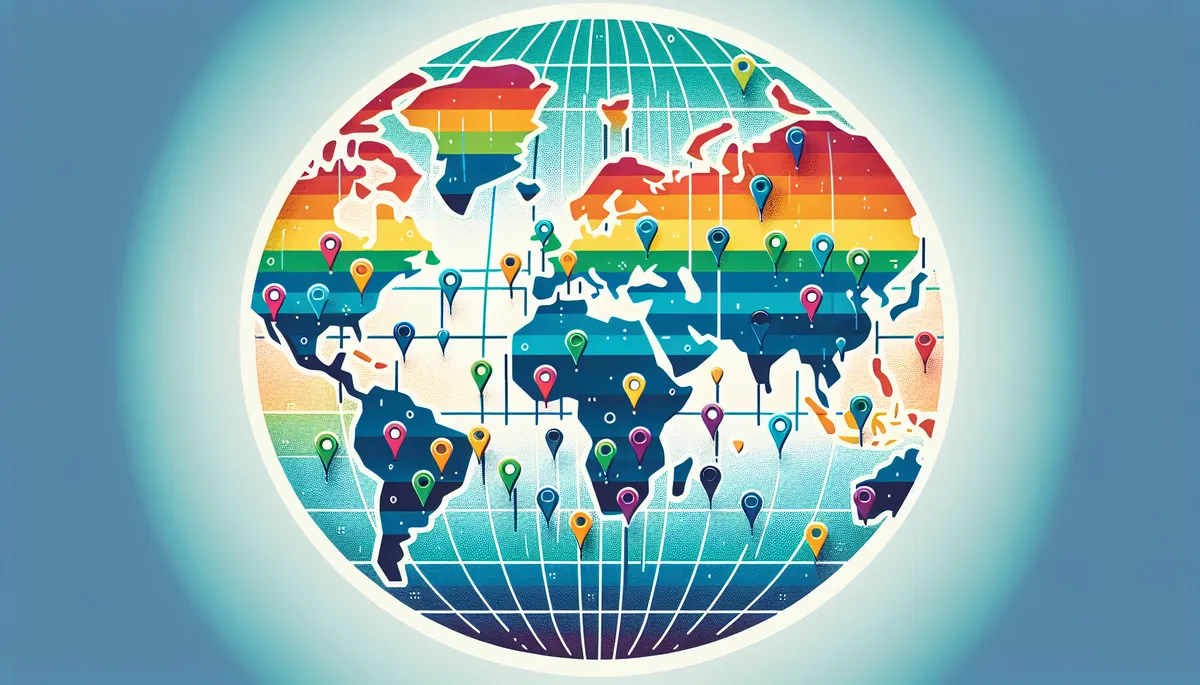
CGLQ, a Global Observer with UN ECOSOC
On July 24, 2007, the Coalition gaie et lesbienne du Québec (CGLQ) obtained consultative status with the United Nations Economic and Social Council (ECOSOC). This accreditation, detailed on our UN / ECOSOC page, gives CGLQ a unique role among Quebec organizations: that of witness, rapporteur, and advocate for LGBT+ people on the international stage.
Nearly twenty years after this recognition, CGLQ's international mission has never been more relevant. In 2026, the global landscape of LGBT+ rights remains marked by striking contrasts. While some countries have consolidated equal rights, others have intensified repression. Approximately 65 countries still criminalize same-sex relations, and around ten of them provide for the death penalty as punishment. In this context, the presence of a Quebec organization accredited within the UN system is an essential advocacy tool.
The mission of CGLQ is built around a fundamental conviction: LGBT+ rights are universal human rights. This conviction, upheld since the organization's founding in 1992, is now expressed on the broadest stage of all—the United Nations.
CGLQ's Concrete Role at the UN
ECOSOC status is not an honorary title. It comes with concrete prerogatives that CGLQ actively exercises as part of its international mandate.
Reporting Discrimination and Rights Violations
CGLQ can submit written reports to UN specialized bodies to report cases of discrimination, violence, or persecution based on sexual orientation or gender identity. These reports help document the realities experienced by LGBT+ people in countries where data is scarce or censored. They inform the work of the Office of the High Commissioner for Human Rights and the special rapporteurs mandated by the Human Rights Council.
Participation in ECOSOC Sessions
As an accredited NGO, CGLQ can attend ECOSOC sessions, speak during debates, and submit written or oral statements. This presence in UN forums helps keep issues related to sexual orientation and gender identity on the international agenda, even when some member states attempt to marginalize them.
Reports to Specialized Bodies
CGLQ can contribute to the Human Rights Council's Universal Periodic Review (UPR) mechanisms by submitting information on the situation of LGBT+ people in the countries under review. These contributions inform the recommendations made to member states and exert diplomatic pressure in favor of decriminalization and the protection of fundamental rights.
Collaboration with International Organizations
ECOSOC status facilitates CGLQ's collaboration with a global network of organizations committed to defending LGBT+ rights. Among the partners and organizations with which CGLQ maintains ties are ILGA (International Lesbian, Gay, Bisexual, Trans and Intersex Association), the world's largest federation of LGBT+ organizations, and Amnesty International, which systematically documents human rights violations related to sexual orientation. CGLQ also collaborates with Human Rights Watch, OutRight Action International, and several regional organizations.
Russia: Unprecedented Regression
The Russian Federation is one of the most concerning cases worldwide regarding LGBT+ rights. Since 2013, the country has systematically tightened its legislation, a trend that intensified dramatically between 2020 and 2023.
In 2013, Russia adopted a law prohibiting the “propaganda of non-traditional sexual relations” to minors. This legislation, denounced by international human rights organizations, was expanded in December 2022 to apply to the entire population, across all age groups. Any positive representation of homosexuality in the media, cinema, literature, or on the Internet can now be punished with substantial fines.
The 2020 constitutional amendments enshrined in Russia's fundamental law the definition of marriage as an exclusive union between a man and a woman, effectively ruling out any possibility of legal recognition for same-sex couples. Our article on same-sex couples in Russia details the social reality of these couples, estimated to number approximately 214,000, who live in forced invisibility.
The gravest step was taken in November 2023, when Russia's Supreme Court designated the “international LGBT movement” as an “extremist” organization. This decision, unprecedented in a G20 country, effectively criminalizes any visible advocacy for LGBT+ rights on Russian territory. Organizations were forced to cease their activities or continue their work from abroad.
The issue of cultural exchanges between Quebec and Russia raises complex challenges in this context. Understanding the social realities of Slavic countries, including by exploring Slavic cultures and their specific characteristics, provides better insight into the challenges faced by LGBT+ people in these societies, where patriarchal traditions exert considerable pressure.
CGLQ closely monitors this deterioration and uses its ECOSOC status to document and report these systematic human rights violations to UN bodies.
Ukraine: Between War and Closer European Ties
The situation of LGBT+ people in Ukraine presents a complex picture, profoundly influenced by the armed conflict with Russia and the country's European aspirations. Our article on lesbian rights in Ukraine provides a detailed analysis of this reality.
Homosexuality is not criminalized in Ukraine, but there is no legal recognition of same-sex couples. The war, which began in February 2022, has paradoxically accelerated some discussions about civil rights. Several factors are contributing to this development:
- The military service of LGBT+ people in the defense of the country has made their contribution visible and helped reduce stigma in some segments of society
- The European Union accession process, which requires alignment with European human rights standards, is exerting pressure in favor of legislative reforms
- Discussions on civil partnerships have begun within the Ukrainian parliament, particularly to address the concerns of same-sex couples in which one partner is serving on the front lines and who have no legal rights toward one another
- Civil society support for LGBT+ rights has grown, with polls showing a positive shift in attitudes, particularly among younger generations
Nevertheless, significant challenges remain. Homophobia remains widespread in some regions, and violence against LGBT+ people is not adequately prosecuted. CGLQ is closely monitoring these developments and contributes its human rights expertise to international discussions on the situation in Ukraine.
Africa: Persistent Criminalization and Isolated Progress
The African continent has one of the most concerning records regarding LGBT+ rights. In 2026, more than 30 African countries criminalize same-sex relations, with penalties ranging from imprisonment to the death penalty.
Among the most critical situations:
- Uganda: the 2023 Anti-Homosexuality Act, one of the harshest in the world, provides for the death penalty for “aggravated homosexuality” and life imprisonment for consensual same-sex acts. It also criminalizes failure to report a homosexual person
- Nigeria: the 2014 law prohibits same-sex marriage and unions throughout the country, with penalties of up to 14 years in prison in the south and the death penalty in northern states where Sharia law is enforced
- Ghana: a bill passed by Parliament in 2024 provides for sentences of up to 5 years in prison for LGBT+ people and up to 10 years for activists
- Mauritania, Somalia: the death penalty remains applicable to same-sex relations
However, notable progress deserves to be highlighted:
- South Africa: the only African country to recognize same-sex marriage (since 2006) and to enshrine protection against discrimination based on sexual orientation in its Constitution. The country remains a model on the continent, despite persistent homophobic violence
- Botswana: in 2019, the High Court decriminalized homosexuality, a decision upheld on appeal in 2021, marking historic legal progress in Southern Africa
- Angola: decriminalized homosexuality in 2021 and added protections against discrimination
- Mozambique: decriminalized homosexuality in its new 2015 penal code
The CGLQ pays particular attention to the African continent in its reports to ECOSOC, documenting both setbacks and progress.
Middle East: A Critical Situation
The Middle East and North Africa are among the most hostile regions in the world for LGBT+ people. Most countries in the region criminalize same-sex relations, and several of them impose the death penalty.
- Iran: same-sex relations are punishable by death under the Islamic penal code. Documented executions for homosexuality occur regularly
- Saudi Arabia: the death penalty applies to homosexual acts under Sharia law. LGBT+ people have no legal protection
- Yemen: the law provides for the death penalty for same-sex relations between men
- United Arab Emirates: homosexuality is criminalized throughout the federation, with penalties of up to life imprisonment
- Iraq: although homosexuality is not explicitly criminalized by the penal code, LGBT+ people face systematic violence from armed militias and their own families
Some recent developments are worth noting. Israel remains the only country in the region to partially recognize LGBT+ rights, with relative social tolerance, a Pride parade in Tel Aviv, and recognition of marriages performed abroad, although same-sex marriages are not performed within its territory.
The CGLQ systematically uses UN mechanisms to draw attention to the situation of LGBT+ people in the Middle East, particularly during the Universal Periodic Review of the countries concerned.
Latin America: Significant Progress
Latin America and the Caribbean present a mixed but generally encouraging picture, with major legislative advances in several countries in the region.
- Argentina: a pioneer in the region, it legalized same-sex marriage in 2010 and adopted one of the world's most progressive gender identity laws in 2012, allowing changes to civil status without medical requirements
- Brazil: same-sex marriage has been recognized since 2013 by a decision of the National Council of Justice. The country also has protections against discrimination, although homophobic violence remains a serious problem, with Brazil recording one of the highest rates of murders of LGBT+ people in the world
- Mexico: same-sex marriage was gradually legalized across all states, with the last adopting this measure in 2022
- Colombia: same-sex marriage has been recognized since 2016, and adoption by same-sex couples is permitted
- Chile: legalized same-sex marriage in 2022
- Cuba: the new Family Code, adopted by referendum in 2022, recognizes same-sex marriage and adoption
Conversely, homosexuality remains criminalized in some Caribbean countries, a legacy of British colonial laws. Jamaica, Guyana, and certain islands retain laws penalizing same-sex relations. The CGLQ supports advocacy efforts for decriminalization in these territories.
Western Europe: Models of Equality
Western Europe and Northern Europe are the most advanced regions in terms of LGBT+ rights. The Netherlands, the first country in the world to legalize same-sex marriage in 2001, paved the way for a series of reforms across the continent.
In 2026, same-sex marriage is recognized in nearly all Western and Northern European countries: Belgium (2003), Spain (2006), Norway (2009), Sweden (2009), Portugal (2010), Denmark (2012), France (2013), United Kingdom (2014), Luxembourg (2015), Ireland (2015), Finland (2017), Germany (2017), Austria (2019), Switzerland (2022), Andorra (2023), Greece (2024).
These countries have also adopted legal protections against discrimination based on sexual orientation in employment, housing, and public services. The European Union has incorporated the fight against discrimination based on sexual orientation into its Charter of Fundamental Rights.
However, disparities persist even in Europe. Some Eastern and Central European countries, such as Poland and Hungary, have adopted restrictive measures. In 2021, Hungary banned the representation of homosexuality in content intended for minors, while dozens of municipalities in Poland declared themselves “LGBT ideology-free zones,” although the European Union condemned these initiatives.
Quebec and Canada as International Models
Quebec and Canada play a leading role in advancing LGBT+ rights worldwide. This reality, at the heart of the CGLQ's mission, is a considerable asset in the organization's international advocacy.
Canada was the fourth country in the world to legalize same-sex marriage, in 2005. But progress in Quebec and Canada extends far beyond this:
- Canadian Charter of Rights and Freedoms: the Supreme Court of Canada interpreted section 15 as including protection against discrimination based on sexual orientation as early as 1995
- Quebec anti-discrimination law: Quebec was among the first jurisdictions in the world to prohibit discrimination based on sexual orientation, as early as 1977, in its Charter of Human Rights and Freedoms
- Civil union: Quebec created civil unions for same-sex couples in 2002, three years before the federal legalization of marriage
- Adoption: Quebec authorized adoption by same-sex couples as early as 2002
- Protection of gender identity: federal law C-16 of 2017 added gender identity and expression as prohibited grounds of discrimination
- Ban on conversion therapy: Canada criminalized conversion therapy in 2022, a measure unanimously adopted by Parliament
Quebec's experience demonstrates that a society can achieve a high degree of inclusion of LGBT+ people while preserving social cohesion. This is precisely the model that the CGLQ promotes before UN bodies. To discover Canada, a country recognized for its openness and its commitment to human rights, one need only observe the breadth of legal protections enjoyed by LGBT+ people throughout the country.
The CGLQ regularly shares this expertise during ECOSOC sessions and in its reports to specialized UN bodies, providing concrete evidence of the benefits of inclusive legislation. To learn more about LGBT rights in Quebec, see our dedicated article.
Comparison table: LGBT+ rights in 20 countries (2026)
The table below provides an overview of the state of LGBT+ rights in 20 countries representing different regions of the world. It illustrates the considerable disparities that persist worldwide.
| Country | Legality | Marriage | Constitutional protection | Adoption |
|---|---|---|---|---|
| Canada | Yes | Yes (2005) | Yes (s. 15 Charter) | Yes |
| France | Yes | Yes (2013) | No | Yes |
| Netherlands | Yes | Yes (2001) | No | Yes |
| Germany | Yes | Yes (2017) | No | Yes |
| Spain | Yes | Yes (2006) | No | Yes |
| Argentina | Yes | Yes (2010) | No | Yes |
| Brazil | Yes | Yes (2013) | No | Yes |
| Mexico | Yes | Yes (2022) | No | Partial |
| South Africa | Yes | Yes (2006) | Yes (Constitution) | Yes |
| Botswana | Yes (2019) | No | No | No |
| Ukraine | Yes | No | No | No |
| Russia | Yes* | Prohibited (Constitution) | No | Prohibited |
| Poland | Yes | No | No | No |
| Hungary | Yes | Prohibited (Constitution) | No | No |
| Uganda | No (life imprisonment) | No | No | No |
| Nigeria | No (14 years / death) | No | No | No |
| Iran | No (death penalty) | No | No | No |
| Saudi Arabia | No (death penalty) | No | No | No |
| Israel | Yes | Recognition of foreign marriages | No | Yes |
| Japan | Yes | No | No | No |
* In Russia, homosexuality is not formally criminalized, but the anti-propaganda law (2022) and the designation of the LGBT movement as “extremist” (2023) create an environment of de facto criminalization.
CGLQ’s international partnerships
The effectiveness of CGLQ’s international advocacy largely depends on its collaboration with a network of organizations that share the same objectives. These partnerships make it possible to pool expertise, share information, and coordinate advocacy efforts before international bodies.
International organizations
- ILGA World: the international federation brings together more than 1 800 organizations in more than 160 countries. CGLQ contributes to its annual reports on state-sponsored homophobia and participates in its regional conferences
- Amnesty International: CGLQ works with Amnesty sections to document human rights violations related to sexual orientation and gender identity
- Human Rights Watch: HRW reports on LGBT+ rights inform CGLQ’s advocacy work before ECOSOC
- OutRight Action International: this organization, which is also accredited to ECOSOC, works with CGLQ on international issues
Canadian and Quebec organizations
- Egale Canada: national LGBT+ rights advocacy organization
- Fondation Émergence: Quebec organization specializing in the fight against homophobia and transphobia
- Conseil québécois LGBT: coordinating organization that brings together Quebec’s LGBT+ associations
These partnerships strengthen CGLQ’s ability to fulfill its international mandate and make the voices of LGBT+ people from Quebec and Canada heard on the world stage. To support this work, you can become a CGLQ member.
See also on the CGLQ website
The role of Canada and Quebec on the international LGBT+ stage
Canada and Quebec occupy a unique position in the international LGBT+ rights landscape. Recognized for their progressive policies and protective legal framework, they play an active role in promoting equality worldwide, both through diplomacy and by welcoming LGBTQ+ refugees fleeing persecution. The international LGBT+ situation cannot be understood without considering Canada’s and Quebec’s contribution to this fundamental human rights issue.
Canadian diplomacy on LGBTQ+ rights
Canada has made LGBTQ+ rights an explicit component of its foreign policy. The Department of Global Affairs integrates the protection of the rights of sexually and gender-diverse people into its bilateral dialogues with partner countries and its interventions in multilateral forums, including the United Nations General Assembly, the Human Rights Council, and the Commonwealth.
Canada is a founding member of the Equal Rights Coalition, an intergovernmental alliance created in 2016 that brings together more than 40 states committed to defending LGBTQ+ rights. Through this coalition, Canada funds capacity-building programs for civil society organizations in countries where LGBT+ rights are threatened or criminalized. In 2025, Canada allocated a budget of more than 30 million dollars over five years to these international aid programs related to LGBTQ+ rights.
Humanitarian aid and the resettlement of LGBTQ+ refugees
Canada is one of the few countries in the world to formally recognize sexual orientation and gender identity as grounds for persecution qualifying individuals for refugee status. Every year, hundreds of LGBTQ+ people obtain asylum in Canada after fleeing countries where their lives were in danger. The private sponsorship program, in which CGLQ actively participates, enables community groups to support the resettlement and integration of LGBTQ+ refugees.
In Quebec, several organizations work together to facilitate the integration of LGBTQ+ refugees. French-language training, legal assistance, and psychosocial support services are offered to address the specific needs of this particularly vulnerable population. CGLQ plays a coordinating role by connecting refugees with resources suited to their circumstances, whether for housing, employment, or health care.
Quebec as a model of equality and inclusion
Quebec is regularly cited as a model for LGBTQ+ rights and inclusion. Its Charter of Human Rights and Freedoms, which has prohibited discrimination based on sexual orientation since 1977, has inspired many laws around the world. Quebec’s legal framework for same-sex parentage, civil unions, and changing sex designations is considered among the most advanced in the world.
The Quebec government adopted a Government Action Plan to Combat Homophobia and Transphobia that sets out concrete measures in education, health, public safety, and the workplace. Developed in consultation with community organizations including CGLQ, this plan demonstrates the political will to keep Quebec at the forefront of inclusive societies. Quebec’s expertise in this area is also sought by governments and international organizations wishing to develop their own inclusion policies.
Persistent international challenges
Despite the commitment of Canada and Quebec, the international LGBT+ situation remains troubling in many regions of the world. Through its status with UN ECOSOC, CGLQ continues to document rights violations and advocate for concrete change. The organization emphasizes the need for Canada to maintain a firm position in its diplomatic relations with countries that criminalize homosexuality and to increase its assistance to persecuted LGBTQ+ people around the world.
The most LGBT-friendly countries in 2026
The state of LGBTQ+ rights varies considerably from country to country. In 2026, some states stand out for their particularly protective legal and social frameworks, while in others, homosexuality remains criminalized.
Countries where LGBTQ+ rights are most advanced
- Canada (including Quebec): marriage equality since 2005, adoption, protection against discrimination, ban on conversion therapy.
- Netherlands: 1st country in the world to legalize same-sex marriage (2001), full rights.
- Spain, Belgium, Sweden, Denmark, Finland: marriage equality, adoption, full protection against discrimination.
- New Zealand, Australia, United Kingdom: strong legal framework with marriage equality and adoption rights.
- Mexico: same-sex marriage legal in all states since 2022.
Where homosexuality is criminalized in 2026
According to ILGA World, in 2026, more than 60 countries still criminalize same-sex relations. In 8 to 11 of these countries, the death penalty may be imposed (Saudi Arabia, Iran, Yemen, Brunei, etc.). This situation affects millions of LGBTQ+ people around the world, many of whom must hide to survive.
The CGLQ supports international organizations working toward global decriminalization. Resources on the international LGBT situation are available on our website, along with information for LGBTQ+ people seeking asylum in Canada.
Frequently asked questions about LGBT+ rights around the world
What is the CGLQ's role at the UN?
The CGLQ has held consultative status with the United Nations ECOSOC since 2007. This status allows it to submit reports on violations of LGBT+ people's rights, participate in ECOSOC sessions, contribute to the Universal Periodic Review, and collaborate with other international NGOs. The CGLQ is the only Quebec LGBT NGO to hold this accreditation.
How many countries still criminalize homosexuality in 2026?
In 2026, approximately 65 countries still criminalize same-sex relations. Of these, around ten provide for the death penalty as punishment, including Iran, Saudi Arabia, Yemen, Mauritania, and some states in northern Nigeria. Penalties in other countries range from fines to life imprisonment.
What is the situation of LGBT+ people in Russia?
Russia has significantly tightened its legislation: the anti-propaganda law expanded in 2022 prohibits any positive representation of homosexuality, the 2020 constitutional amendments prohibit same-sex marriage, and in 2023 the Supreme Court designated the LGBT movement as “extremist.” LGBT+ people live underground, and organizations have been forced to cease their activities.
Is Quebec a model for LGBT+ rights?
Yes. Quebec was among the first jurisdictions in the world to prohibit discrimination based on sexual orientation (1977). It established civil unions in 2002, and Canada legalized same-sex marriage in 2005. Conversion therapies were criminalized in 2022. The CGLQ shares this experience with UN bodies.
How does the CGLQ collaborate with international organizations?
The CGLQ collaborates with ILGA World, Amnesty International, Human Rights Watch, and OutRight Action International. These partnerships make it possible to pool expertise, share data on rights violations, and coordinate advocacy efforts with the United Nations and other international bodies.
Which African countries recognize LGBT+ people's rights?
South Africa is the only African country to recognize same-sex marriage (since 2006) and to enshrine protection against discrimination in its Constitution. Botswana decriminalized homosexuality in 2019, Angola in 2021, and Mozambique in 2015. However, more than 30 African countries still criminalize same-sex relations.
How can I support the CGLQ's international work?
You can support the CGLQ's work by becoming a member of the organization. Membership helps fund international advocacy activities, the drafting of reports for the UN, and participation in ECOSOC sessions. Visit our Become a member page for more information.