2ELGBTQI+, 2SLGBTQIA+: what each letter in the acronym and each color of the Pride flags means
In brief: The Government of Canada officially uses 2SLGBTQI+ in English and 2ELGBTQI+ in French, with 2S/2E placed first to recognize Two-Spirit people as the first communities on the land. This article breaks down the acronym letter by letter, traces the Indigenous origin of the term Two-Spirit, and details the documented history of the main flags: Gilbert Baker's rainbow flag (1978), Daniel Quasar's Progress Pride flag (2018), Morgan Carpenter's intersex flag (2013), and the asexual flag.
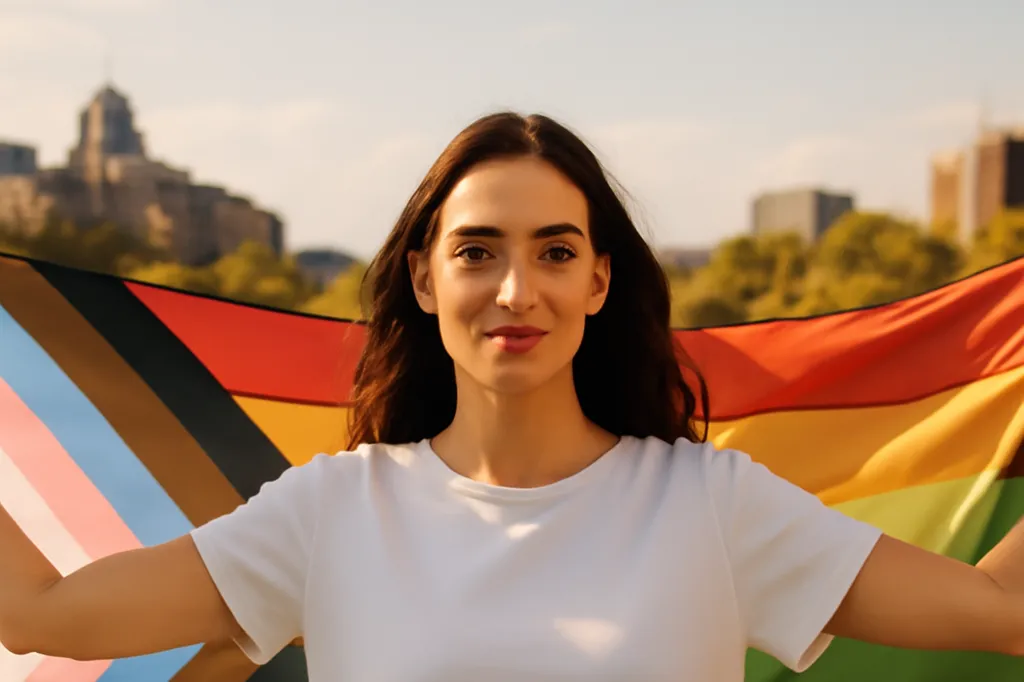
2E/2S first: a federal decision that puts Indigenous peoples at the forefront of the acronym
Ottawa made its decision in 2022: the official federal acronym is written 2ELGBTQI+ in French, while the English version retains 2S in the first position. This spelling difference is not insignificant. In both cases, the number and initial letter refer to Two-Spirit people, but the federal government chose “2E”—an abbreviation of “bispirituel”—to root the terminology in Canadian French. “2S,” meanwhile, comes directly from the English term “Two-Spirit,” coined in 1990 at the Third Annual Intertribal Native American/First Nations Gay and Lesbian Conference in Winnipeg. This typographical choice reflects a political intent: to place at the beginning of the acronym the communities that were the first expressions of diverse genders and sexualities on the land, even before the arrival of Western categories.
“Bispirituel” refers to an identity specific to Indigenous nations that cannot be reduced to the concepts of gay, lesbian, or transgender imported from Europe. This initial positioning resulted from public consultations conducted by the Canadian government as part of its “Sois toi-même / Free to be me” strategy. It breaks with decades of acronyms in which letters were added at the end, often in the historical order in which liberation movements emerged. Here, the timeline is geographic and spiritual rather than chronological.
This federal decision coexists with varying usage in Quebec, where “2SLGBTQIA+” remains common in activist and media circles. The Institut de la statistique du Québec recorded 261 600 people who identified with these communities in 2019-2021, representing 3,9 % of Quebec's population aged 15 and over, a figure examined in detail in our report on the LGBTQ+ percentage in Quebec. Across Canada, Statistics Canada estimates this proportion at 4,4 %. Among them, 9 865 transgender people (0,14 %) and 6 360 non-binary people (0,09 %) live in Quebec according to 2021 data, while Canada has 100 815 transgender or non-binary people, representing 0,33 % of those aged 15 and over. These figures, still underestimated by census methodologies, underscore the importance of structuring visibility—with the official acronym as its primary vehicle.
Letter by letter: what each initial in 2ELGBTQI+ covers in Ottawa's official version
Ottawa has made its decision: in French, the official federal acronym is written 2ELGBTQI+, not 2SLGBTQIA+. “2E” retains the same meaning as the English “2S”—Two-Spirit—but the letter changes to fit French morphology. This is not a typographical affectation. The Canadian government updated this wording following public consultations as part of the Sois toi-même / Free to be me strategy. Placing “2E” first recognizes Two-Spirit people as the first 2ELGBTQI+ communities on the land, a symbolic hierarchy that challenges the systematic erasure of Indigenous knowledge from dominant queer narratives.
Each initial carries measurable political weight. “L” stands for lesbian, “G” for gay, “B” for bisexual, and “T” for transgender people. “Q” stands for “queer,” a once-derogatory term reclaimed as a critical umbrella term. “I” stands for intersex people, whose specific flag—a purple circle on a yellow background, designed by Morgan Carpenter in 2013—is now displayed alongside the Progress Pride flag. “A,” which is sometimes controversial, stands for asexuality in the English federal version, although the official Canadian acronym ends with “+” to refer to identities not explicitly named. This economy of letters does not erase internal tensions: some communities advocate including “A” within the acronym itself, while others believe that “+” provides sufficient visibility without instrumentalizing them.
“Bispirituel” deserves closer attention. Used in Canadian French as a possible equivalent of Two-Spirit, the term remains a translation, not an interchangeable identity in every context. It denotes a distinct Indigenous identity that cannot be reduced to Western categories of gender and sexuality. This specificity explains why Ottawa keeps “2” as a prefix in both languages: it roots Canada's queer community in a precolonial timeline that American or European acronyms often overlook.
Statistics Canada figures provide a sense of the scale of this mosaic of identities. Approximately 4,4 % of people aged 15 and over identify as 2SLGBTQ+ nationwide. In Quebec, the proportion reached 3,9 % between 2019 and 2021, representing 261 600 people. Data from May 2021 counted 100 815 transgender or non-binary people across Canada (0,33 % of the population in question). The Institut de la statistique du Québec provides a more detailed picture: 9 865 transgender people (0,14 %) and 6 360 non-binary people (0,09 %) live in the province. These figures, available on statcan.gc.ca and statistique.quebec.ca, do not capture the full spectrum that “+” seeks to encompass.
The official federal acronym breaks down as follows:
- 2E/2S — bispirituel / Two-Spirit, a distinct Indigenous identity that cannot be reduced to Western categories
- L — lesbian
- G — gay
- B — bisexual
- T — transgender
- Q — queer
- I — intersex
- A — asexual
- + — other identities not explicitly named
Bispirituel or Two-Spirit: an identity that resists Western translation
Ottawa made its decision in 2022: the official federal acronym is written 2ELGBTQI+ in French, whereas English uses 2SLGBTQI+. The difference is not a typo. “2E” places Two-Spirit people first, thereby recognizing Indigenous communities as the first expressions of diverse genders and sexualities on this land. This decision emerged from public consultations conducted as part of the federal “Sois toi-même / Free to be me” strategy. The gesture is symbolic, but it carries considerable political weight in a country marked by the history of Indigenous residential schools.
The term “bispirituel” serves as a possible equivalent of Two-Spirit, yet it remains a translation. The Indigenous nations on the land now known as Canada have concepts of gender and sexuality that predate and extend beyond Western categories. Two-Spirit identity is not simply an addition to the acronym: it refers to a specific spiritual, social, and cultural role that varies among nations. Reducing this identity to a letter in an alphabetical sequence, even one placed first, carries the risk of administrative appropriation. The federal government recognized this by reserving the letter “S” for English, where Two-Spirit retains its linguistic integrity, and adopting “2E” in French, where “esprit” more directly evokes the spiritual dimension being asserted.
This tension around translation fuels debate within the communities themselves. Some Indigenous activists prefer to use “Two-Spirit” in full in French, considering “bispirituel” inadequate. Others value the effort to render the term in French. CGLQ, founded in 1992 and accredited by UN ECOSOC, closely follows these discussions. One fact remains constant: 2E/2S people represent a population whose statistical visibility remains fragmented. Statistics Canada does not count Two-Spirit people separately in its standard surveys, although the Institut de la statistique du Québec recorded 9 865 transgender people and 6 360 non-binary people in Quebec in 2021. The absence of a specific figure for 2E populations illustrates the limitations of measurement tools when faced with identities that resist predefined categories.
Before using the acronym in a public communication, three precautions can help avoid the most common missteps:
- Do not confuse translation with equivalence. “Bispirituel” translates Two-Spirit, but it does not refer to an interchangeable identity in every context; its use by non-Indigenous people raises questions.
- Pay attention to the language being used. Since 2022, the federal government has written 2ELGBTQI+ in French and 2SLGBTQI+ in English, creating an asymmetry worth noting depending on the intended audience.
- Recognize variations in Quebec. Media usage here often uses 2SLGBTQIA+, with an A that the federal acronym excludes and an S retained even in French.
- Accept the fluidity of the letters. The order changes depending on the context; no version is universally established.
From Baker to Quasar: How the Rainbow Flag Was Overtaken by Its Own Successors
The rainbow flag that Gilbert Baker made in San Francisco in 1978 had eight stripes. Pink and turquoise quickly disappeared for practical reasons—dyes unavailable for mass production—leaving the six canonical colours that the Canadian federal government still lists today: red, orange, yellow, green, blue, violet. A general symbol of diversity, this flag was long sufficient. It no longer is.
Daniel Quasar, a non-binary designer based in Portland, understood this tension in 2018. Their Progress Pride flag retains the six horizontal stripes but adds a five-colour diagonal chevron: white, pale pink and pale blue borrowed from the transgender flag, plus black and brown to explicitly represent Black, Indigenous and racialized people whom the original design rendered invisible. This arrow-like geometry, pointing forward, breaks with the spectrum's apparent uniformity. An expanded version, the Intersex-Inclusive Progress Pride, has since incorporated a yellow triangle with a violet circle—the colours of the intersex flag designed in 2013 by Australian Morgan Carpenter.
Carpenter had sought to create radically non-gendered symbolism. Yellow, a colour rarely associated with pink and blue gender norms, asserts autonomy and visibility. Violet evokes the bodily integrity and potential of intersex people. Finally, the circle rejects any binary hierarchy: wholeness without a breaking point. This flag addressed a specific void. The flag of asexual people, meanwhile, features four horizontal stripes: black for asexuality, grey for the asexual spectrum and grey-asexuality, white for allosexuality and the broader community, and violet for solidarity within this group, which is often rendered statistically invisible.
These successive iterations do not constitute a repudiation of Baker. Rather, they reflect a growing demand for precision within a movement that, in Canada, includes approximately 4,4 % of people aged 15 and older, according to Statistics Canada. In Quebec, the proportion reaches 3,9 %, or 261 600 people in 2019-2021. Among them, in May 2021, the Institut de la statistique du Québec counted precisely 9 865 transgender people and 6 360 non-binary people—figures that justify symbols evolving as much as vocabulary does.
Daniel Quasar's Chevron (2018): How Progress Pride Redefined Inclusion in Black, Brown, Pink and Pale Blue
The rainbow flag embodies the turbulent history of a community that has continually had to reinvent its symbols to reflect its changing reality. Created in 1978 by Gilbert Baker, the flag originally featured eight coloured stripes, each with a specific meaning: pink for sex, red for life, orange for healing, yellow for sunlight, green for nature, turquoise for magic, indigo for serenity and violet for spirit. This luxuriant version was short-lived: production constraints led to the disappearance of pink and then turquoise, leaving the six-stripe flag that would become the global emblem of Pride. This transition from eight to six colours is more than a technical anecdote: it already reveals the tension between symbolic ambition and material constraints, between the desire to include and the forces pushing toward uniformity.
Forty years later, this tension resurfaced with renewed urgency. In 2018, non-binary designer Daniel Quasar proposed Progress Pride, a flag that not only adds colours but reorganizes the very geometry of the design. A right-pointing chevron is inserted on the left side of the classic rainbow flag, creating a sense of movement and progress. This chevron borrows the white, pale pink and pale blue stripes of the trans flag, then adds two more stripes: black and brown. Black gives visibility to people living with HIV and honours those who died of AIDS, recalling an epidemic too quickly relegated to the archives. Brown asserts the place of Black, Indigenous and racialized people within a movement that has not always been exemplary in its anti-racism. This spatial reorganization is not neutral: it places the margins at the centre and brings trans and racial issues to the forefront.
Progress Pride has itself given rise to descendants, demonstrating the symbol's endless capacity for recombination. The Intersex-Inclusive Progress Pride version incorporates a yellow triangle adorned with a violet circle, borrowed directly from the intersex flag designed by Morgan Carpenter in 2013. Yellow proclaims the autonomy and visibility of a body that rejects binary assignment; violet asserts physical integrity and the potential of an existence outside established norms. The circle, a perfect shape without beginning or end, evokes a wholeness unfolding without gender hierarchy. This layering of symbols does not result in confused eclecticism: it constructs a visual grammar in which every element engages with the others and the movement's history can be read like geological strata.
This proliferation of flags sometimes provokes exasperation or even mockery. Critics denounce identity fragmentation and a narcissism of minor differences. Yet every modification of the rainbow flag addresses a concrete question: who remains in the shadow of this symbol that is meant to unite? Adding colours is not an aesthetic sectarian dispute; it reflects real power dynamics within a community that has never been monolithic. Far from being an immutable totem, the flag functions as a renegotiated social contract: it expresses both what we have become and what we still aspire to become. In this sense, Progress Pride and its derivatives do not betray Gilbert Baker's legacy: they fulfil its most radical promise—that of a living symbol capable of transforming without dissolving.
Morgan Carpenter's Violet Circle (2013): Yellow and Purple as an Assertion of Bodily Integrity
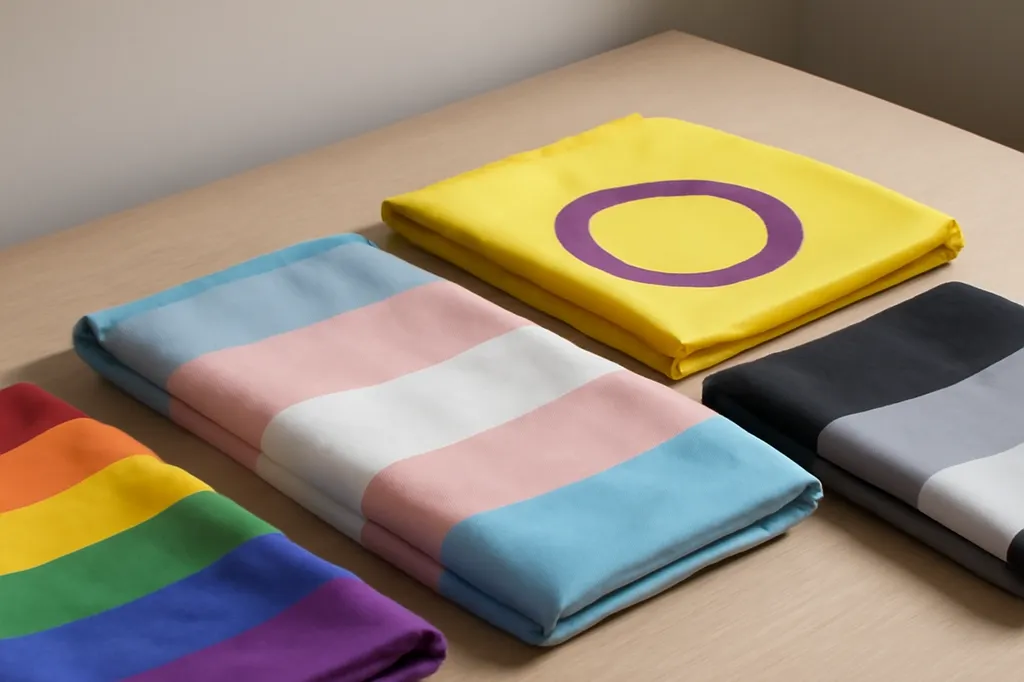
The intersex flag did not emerge from an aesthetic trend. Morgan Carpenter, an Australian activist, designed it in 2013 to address a glaring symbolic void: people born with variations in sex characteristics—historically labelled by medicine with medicalizing acronyms and sometimes subjected to surgery without consent from childhood—had no banner of their own. Carpenter chose two colours and a geometric shape, each carrying an explicit political meaning. Yellow, a rare colour in Western gender symbolism, evokes denied autonomy and visibility. Violet, traditionally associated with royalty but repurposed here, asserts the bodily integrity, wholeness and potential of intersex people. The central circle, closed and unbroken, represents the wholeness of a person whom neither the gender binary nor surgical interventions could complete or diminish.
This symbolism resonates differently in Canada, where Statistics Canada counts transgender and non-binary people—100 815 nationwide in May 2021, or 0,33 % of those aged 15 and older—but where data on intersex people remain fragmented, buried in medical categories or ignored by administrative forms. The Institut de la statistique du Québec does not publish a separate figure for this population. Carpenter's flag therefore functions as a tool of symbolic enumeration: in the face of statistical invisibility, yellow and violet assert a collective existence.
The expanded version of the Progress Pride flag, subsequently designed from Daniel Quasar's 2018 model, incorporates Carpenter's yellow triangle and violet circle into its chevron. This incorporation is significant: it places intersex people at the heart of a broader Pride narrative while preserving the specificity of a struggle—bodily integrity—that extends beyond the usual frameworks of 2SLGBTQI+ advocacy. The circle, a shape without angles or points, rejects hierarchy. It says: no body is incomplete, no variation needs to be corrected.
Here, at a glance, is what each of the main flags seen in Quebec today represents:
| Flag | Year and creator | Distinctive colours | What they mean |
|---|---|---|---|
| Rainbow | 1978, Gilbert Baker | Originally eight stripes, six today (red, orange, yellow, green, blue, violet) | General symbol of diversity |
| Progress Pride | 2018, Daniel Quasar | White, pale pink, pale blue, black and brown chevron added to the rainbow | Trans colours, people living with HIV and those who died of AIDS, Black, Indigenous and racialized people |
| Intersex-Inclusive Progress Pride | Expanded version of the preceding flag | Yellow triangle and violet circle added | Explicit inclusion of intersex people |
| Intersex | 2013, Morgan Carpenter | Violet circle on a yellow background | Yellow = autonomy and visibility, violet = integrity and potential, circle = wholeness without gender hierarchy |
| Asexual | Creator undocumented | Black, grey, white, violet | Asexuality, asexual spectrum, broader community, solidarity |
| Transgender | Creator undocumented | Pale blue, pale pink, white | Colours used in the Progress Pride chevron |
In Quebec, who makes up these communities? Figures from Statistics Canada and the Institut de la statistique du Québec
Official data paint a more nuanced picture than the stereotypical image of a homogeneous, predominantly Montreal-based community. In Quebec, 261 600 people aged 15 and over identified as 2SLGBTQ+ between 2019 and 2021, representing 3,9 % of the province's adult population according to Statistics Canada. This figure is slightly below the Canadian average of 4,4 %, a difference that deserves careful interpretation: it may reflect differences in self-reporting as much as actual prevalence, with distrust of government institutions varying across regions and generations.
Trans identity, often rendered invisible in mainstream discourse, nevertheless concerns thousands of Quebecers counted in official data. The Institut de la statistique du Québec recorded 9 865 transgender people in 2021 (0,14 % of those aged 15 and over) and 6 360 non-binary people (0,09 %). These seemingly modest proportions represent entire lives facing specific systemic barriers: access to gender-affirming care, violence in public spaces, and denial of care. At the national level, the May 2021 census counted 100 815 transgender or non-binary people, representing 0,33 % of Canada's adult population.
These figures warrant a critical reading. They likely underestimate the realities, as census methodologies struggle to capture fluid identities, people who do not disclose their identity out of fear or distrust, and those who do not see their own lived experience reflected in the available categories. The “plus” in 2SLGBTQI+ specifically encompasses these identities that are not explicitly named, those that still fall outside government frameworks. For Quebec readers seeking to understand, these data are not merely demographic curiosities: they measure the distance between the political visibility achieved and the persistent invisibilization of a significant portion of the population.
Frequently asked questions
Why does Canada use 2ELGBTQI+ in French and 2SLGBTQI+ in English?
The federal government updated its official acronym following public consultations as part of the “Sois toi-même / Free to be me” strategy. In French, 2E refers to “bispirituel,” a proposed equivalent of the English term “Two-Spirit.” In both languages, placing it first recognizes Two-Spirit people as the original communities of the land.
What does each letter in the acronym 2SLGBTQIA+ mean?
2S or 2E refers to Two-Spirit people, a distinct Indigenous identity that cannot be reduced to Western categories; L stands for lesbian, G for gay, B for bisexual, T for transgender, Q for queer, I for intersex, A for asexual, and the + for identities that are not explicitly named.
Who created the Progress Pride flag, and what do its colours mean?
The Progress Pride flag was created in 2018 by Daniel Quasar, a non-binary designer. It incorporates the rainbow flag and adds a chevron combining the white, light pink, and light blue of the transgender flag, along with black, which brings visibility to people living with HIV and honours those who died of AIDS, and brown, which affirms the place of Black, Indigenous, and racialized people.
Where did the yellow and purple intersex flag come from?
It was designed in 2013 by Morgan Carpenter: a purple circle on a yellow background. Yellow represents autonomy and visibility, purple represents the integrity and potential of intersex people, and the circle evokes wholeness without a gender hierarchy. It was later incorporated into the Intersex-Inclusive Progress Pride flag as a yellow triangle and purple circle.
Should one say “bispirituel” or “Two-Spirit” in French?
“Bispirituel” is used in Canadian French as a possible equivalent of Two-Spirit, but it remains a translation, not an interchangeable identity in every context. Some Indigenous people prefer to retain the English term to emphasize its cultural specificity. When in doubt, using the term chosen by the person or organization concerned remains the safest rule.