Marriage equality in Quebec: a timeline of a historic victory
In brief: On July 20, 2005, Canada became the fourth country in the world to legalize same-sex marriage. But this victory was the result of decades of legal and activist struggles in which Quebec played a leading role. From the recognition of common-law partners (1999) to civil unions (2002), followed by the historic ruling of the Quebec Court of Appeal (2004), the province paved the way toward marriage equality. Twenty years later, the overall outcome is very positive, but challenges remain.
The context before 2005: a changing society
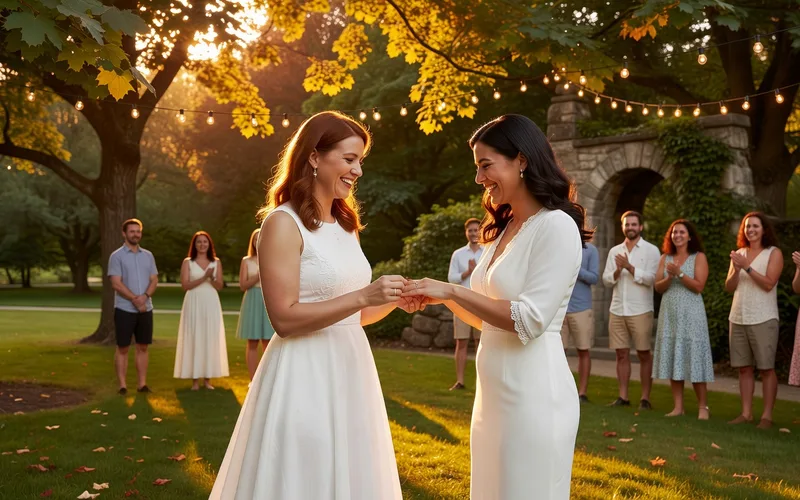
To understand the significance of the legalization of marriage equality in Quebec, we must look back at the decades that preceded it. By profoundly secularizing Quebec society, the Quiet Revolution of the 1960s laid the groundwork for gradually embracing the demands of sexual minorities. The separation of church and state made it possible to redefine marriage as a civil rather than strictly religious institution.
Beginning in the 1970s, the gay and lesbian liberation movement took root in Montreal, where the Gay Village became a symbol of community visibility. Activists first demanded decriminalization (achieved in 1969), followed by protection against discrimination (secured in 1977 through an amendment to the Quebec Charter), before turning their attention to the recognition of same-sex unions.
The 1980s were marked by the AIDS crisis, which paradoxically strengthened community solidarity and made same-sex couples more visible in the public sphere. Heartbreaking situations—partners excluded from medical decisions, denied inheritance, and ignored by legal systems—highlighted the urgent need for legal recognition of same-sex couples.
In the 1990s, Quebec society evolved rapidly. Polls showed growing acceptance of homosexuality. The media addressed LGBT+ realities increasingly openly. Same-sex couples lived openly, and the issue of legal recognition of their unions became an unavoidable political concern. For many LGBT+ people, making authentic connections in Quebec is now easier thanks to this growing social acceptance.
It was in this fertile social climate that the first concrete demands for same-sex marriage emerged, championed by organizations such as the CGLQ and supported by progressive lawyers and lawmakers.
The first demands for marriage equality
Before advocating for marriage, Quebec's LGBT+ movement proceeded in stages. The first major victory was Bill 32, adopted in 1999 by the National Assembly of Quebec. This law amended 28 statutes and 11 regulations to grant same-sex partners the same rights and obligations as opposite-sex common-law partners, affecting pension plans, automobile insurance, social assistance, and inheritance law.
In 2000, the federal government followed suit with Bill C-23, which extended the benefits and obligations associated with common-law partners to same-sex couples in 68 federal statutes. Immigration, taxation, and pensions were now accessible on an equal basis.
Then, in 2002, Quebec took a decisive step with Bill 84, which created the civil union. Quebec thus became the first jurisdiction in Canada to offer same-sex couples a legal framework equivalent to marriage, including parentage, family patrimony, and support obligations. For many, only one step remained: opening marriage itself to same-sex couples.
The CGLQ actively participated in each of these stages, submitting briefs to parliamentary committees, organizing awareness campaigns, and maintaining political pressure as part of its broader work of supporting the LGBT+ community in Quebec. The organization argued that although civil unions were significant, they maintained an unequal symbolic distinction between opposite-sex and same-sex couples.
At the same time, same-sex couples applied for marriage licences from the relevant authorities, receiving refusals that paved the way for decisive court challenges. The legal strategy, coordinated between community organizations and law firms specializing in human rights, proved successful.
Landmark rulings: Quebec and Ontario
The legal battle for marriage equality unfolded simultaneously in several Canadian provinces. Ontario was first: on June 10, 2003, the Ontario Court of Appeal issued a historic ruling in Halpern v. Canada, declaring that the traditional definition of marriage as a union between one man and one woman was unconstitutional under the Canadian Charter of Rights and Freedoms.
This Ontario ruling took effect immediately: the first same-sex marriages in Ontario were performed on the very day the decision was issued. The federal government, led by Jean Chrétien, decided not to appeal the ruling and instead announced its intention to legislate on the issue.
In Quebec, the process followed a parallel course. In March 2004, the Quebec Court of Appeal likewise issued a ruling declaring the restriction of marriage to opposite-sex couples unconstitutional. The ruling was unanimous and unequivocal: the Canadian Charter guarantees gay and lesbian people the fundamental right to marry.
The Quebec decision relied in particular on section 15 of the Canadian Charter (the right to equality) and on the Supreme Court of Canada's case law in previous cases. The judges emphasized that civil marriage is a constantly evolving institution and that denying it to same-sex couples constitutes discrimination based on sexual orientation.
Other provinces quickly followed: British Columbia, Manitoba, Nova Scotia, Saskatchewan, and New Brunswick issued similar rulings. On the eve of the federal law's adoption, same-sex marriage was already legal in most Canadian provinces as a result of court decisions.
Bill C-38: marriage for all in Canada
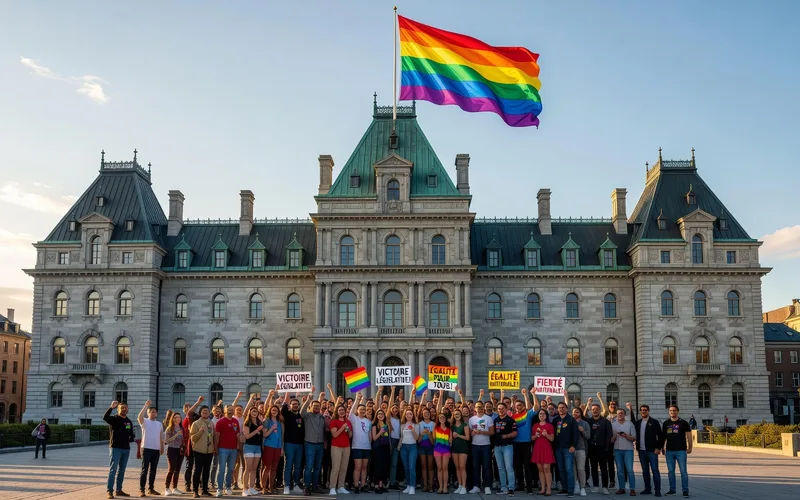
On July 20, 2005, the federal Parliament adopted the Civil Marriage Act (Bill C-38), which redefined marriage as “the lawful union of two persons to the exclusion of all others.” Canada became the fourth country in the world to legalize marriage equality, after the Netherlands (2001), Belgium (2003), and Spain (2005).
The parliamentary debate preceding the law's adoption was intense. Paul Martin's Liberal government faced vigorous opposition from the Conservative Party and religious groups. Liberal caucus members were given a free vote, meaning that each Member of Parliament voted according to their conscience. The bill passed by 158 votes to 133.
Bill C-38 included a provision protecting religious freedom: no religious official was required to perform a marriage contrary to their beliefs. This provision, which preserved the balance between equality and religious freedom, helped defuse some of the opposition.
In Quebec, the law was welcomed with relief and pride by the LGBT+ community. Celebrations were widespread, and civil registry offices saw a remarkable influx of couples wishing to formalize their union. For many, this day marked the end of a long period of exclusion and the beginning of an era of full recognition.
The CGLQ issued a historic statement celebrating this victory and paying tribute to the couples, activists, and lawyers who had championed this cause for decades. The organization emphasized that marriage equality was not an end point, but rather one stage in a broader struggle for genuine equality for LGBT+ people.
To understand the history that made marriage equality possible:
› History of the LGBT movement in Quebec: interview with a gender studies researcher
Reactions and Public Debate
The adoption of Bill C-38 sparked mixed reactions within Canadian society. In Quebec, the response was largely positive. Polls at the time showed that a majority of Quebecers supported same-sex marriage, with the province recording the highest approval rates in Canada.
Several factors explain Quebec's openness. The advanced secularization of society, inherited from the Quiet Revolution, diminished the influence of religious discourse on matters of private morality. Quebec's legal tradition, based on civil law and the Quebec Charter, accustomed the population to a progressive understanding of fundamental rights.
Nevertheless, some voices opposed this reform. Certain religious groups denounced it as an attack on the traditional definition of marriage. Conservative members of Parliament promised to reopen the debate if they came to power. In 2006, Stephen Harper's new government put the issue to a free vote in the House of Commons, but the motion to reopen the debate was defeated by 175 votes to 123. Marriage equality was now firmly established.
In academic and legal circles, Canada's decision was hailed as a model for reconciling fundamental rights and religious freedoms. Researchers around the world studied the “Canadian model” of progressive legalization, which proceeded through judicial steps before federal legislation.
Quebec media played a positive role in normalizing marriage equality. Reports on the first marriages, moving testimonials from couples, and balanced coverage of the debate helped establish the idea that this reform was a matter of justice and fundamental rights rather than an ideological whim.
Testimonials and Life Stories
Beyond legal decisions and statistics, marriage equality is above all a human reality. Thousands of Quebec couples have seen their love recognized by law, and each story carries a deeply personal and moving dimension.
Couples who had lived together for 20 or 30 years were finally able to formalize their union, thereby obtaining legal recognition of their mutual commitment. For many, marriage was not merely an administrative formality, but an emotionally charged act, often celebrated in the presence of entire families that had themselves traveled a journey toward acceptance.
Some testimonials highlight the intergenerational impact of marriage equality. Older parents, who had long struggled to accept their child's sexual orientation, find in the wedding ceremony an opportunity for reconciliation and celebration. Grandparents discover the joy of seeing their family grow in all its diversity.
For couples who had children before legalization, marriage provided long-awaited legal security. Parentage is now established clearly and indisputably, protecting the children and the non-biological parent in the event of separation or death.
These life stories illustrate a fundamental reality: marriage equality is not a legal abstraction, but a right that tangibly transforms the lives of people and families. It offers dignity, security, and recognition to thousands of Quebecers and follows in the footsteps of the LGBT+ rights in Quebec achieved over the decades.

To hear the story from the perspective of an activist who witnessed the achievement of marriage equality:
› LGBTQ+ Activism in Quebec: Interview with a Historic Figure of the Movement
Taking Stock 20 Years Later: Where Do We Stand?
Twenty years after Bill C-38 came into force, the record of marriage equality in Quebec is largely positive. Thousands of same-sex couples have married in the province, and the institution of marriage has not been weakened—instead, it has been enriched by the inclusion of these new family realities.
The concerns expressed by opponents in 2005 did not materialize. Same-sex marriage did not undermine different-sex marriage, did not harm children raised in same-sex-parent families, and did not restrict religious freedom. Longitudinal studies confirm that children raised by same-sex couples develop just as well as those raised by different-sex couples.
Legally, Quebec family law now treats same-sex couples as fully equal. Rules concerning divorce, division of family property, support payments, and child custody apply without distinction. Notaries and lawyers specializing in family law handle cases involving same-sex couples with the same expertise as those involving different-sex couples.
However, challenges remain. Some same-sex couples still face discrimination in administrative procedures or dealings with service providers. Binational couples sometimes encounter obstacles related to the non-recognition of their marriage in the country of origin of one of the spouses.
The CGLQ continues to document these situations and work with the relevant authorities to ensure that legal equality translates into genuine equality in every aspect of daily life.
Quebec as an International Inspiration
Quebec and Canada's experience with marriage equality has become a global benchmark. Many countries studied the Canadian model before proceeding with their own legalization: South Africa (2006), Norway (2009), Sweden (2009), Argentina (2010), France (2013), the United States (2015), Germany (2017), Tawan (2019), among others.
Timeline: The Legalization of Marriage Equality Around the World
| Country | Year | Global rank |
|---|---|---|
| Netherlands | 2001 | 1st |
| Belgium | 2003 | 2nd |
| Canada (Quebec/Ontario as early as 2003-2004) | 2005 | 4th |
| Spain | 2005 | 3rd |
| South Africa | 2006 | 5th |
| France | 2013 | 13th |
| United States | 2015 | 21st |
| Taiwan | 2019 | 27th |
Through its accreditation with the United Nations ECOSOC, the CGLQ shared Quebec's expertise at international forums. The organization presented reports detailing the legalization process in Canada, lessons learned, and the positive social impacts of marriage equality.
In 2026, more than 35 countries have legalized same-sex marriage. However, in more than 60 countries, homosexuality remains criminalized. The gap between these two realities underscores the importance of international advocacy and sharing successful experiences such as Quebec's. To learn more, read our article on the international LGBT+ situation.
Quebec's journey demonstrates that gradual progress—decriminalization, protection against discrimination, recognition of unions, and then marriage—can lead to lasting changes that are widely accepted by the population. This gradual model is often recommended to countries embarking on their own reforms.
Quebec does not export a single model, but offers a concrete example of what is possible when political will, community activism, and judicial support converge toward a shared goal of equality.
The Role of the CGLQ in the Fight for Marriage Equality
The Coalition gaie et lesbienne du Québec (CGLQ) played a key role in the fight for marriage equality. Founded in 1992, the organization supported every stage of the process, from the recognition of common-law partners to the passage of Bill C-38.
The CGLQ submitted detailed briefs to parliamentary committees, both at the National Assembly and the federal Parliament. Based on rigorous legal analyses and testimony from affected couples, these documents helped inform public debate and persuade undecided parliamentarians.
The organization also conducted public awareness campaigns, including conferences, publications, and media appearances. The CGLQ ensured that directly affected couples were given a voice, humanizing the debate beyond legal arguments.
Since 2005, the CGLQ has continued its oversight work to ensure that marriage equality is fully respected in practice. The organization intervenes when incidents of discrimination or denial of service are reported, and it maintains pressure to ensure that formal equality translates into substantive equality. To learn more about the organization's activities, visit the Our Mandate page.
In 2025, to mark the 20th anniversary of Bill C-38, the CGLQ organized a series of commemorative events highlighting the progress made and the challenges that remain. These activities helped pass the history of activism on to new generations and renew the commitment to equal rights.
Key takeaways:
- Quebec legalized same-sex marriage as early as March 2004, before the federal Bill C-38 of July 2005.
- Canada was the fourth country in the world to legalize marriage equality, after the Netherlands, Belgium, and Spain.
- Twenty years later, public support in Quebec exceeds 85 %, one of the highest rates in the world.
- Quebec's model of gradual progress (decriminalization, protection, civil union, marriage) continues to inspire other jurisdictions today.
More to Read on the CGLQ Website
Frequently Asked Questions About Marriage Equality in Quebec
How long has same-sex marriage been legal in Quebec?
Same-sex marriage has been legal in Quebec since March 2004, following the ruling by the Quebec Court of Appeal. It was legalized throughout Canada on July 20, 2005, by the Civil Marriage Act (C-38).
Was Canada the first country to legalize marriage equality?
No, Canada was the fourth country in the world to legalize same-sex marriage, after the Netherlands (2001), Belgium (2003), and Spain (2005). However, Quebec and Ontario were among the first jurisdictions in the world to authorize these marriages through court rulings (2003-2004).
What rights does marriage grant same-sex couples in Quebec?
Marriage grants same-sex couples exactly the same rights as heterosexual couples: family patrimony, matrimonial regime, support obligations, presumed parentage, inheritance rights, pension plans, tax benefits, and all rights associated with spousal status.
Can a religious official refuse to perform a same-sex marriage?
Yes. The Civil Marriage Act (C-38) explicitly provides that religious authorities are not required to perform a marriage that conflicts with their religious beliefs. However, civil officiants (clerks, notaries) are required to perform any legally valid marriage without discrimination.
Could marriage equality be challenged in Canada?
It is highly unlikely. Marriage equality is based on both federal legislation and constitutional jurisprudence under the Canadian Charter of Rights and Freedoms. In 2006, an attempt to reopen the debate was defeated in Parliament, and the social consensus surrounding this reform has grown considerably stronger since then. All current federal political parties support maintaining marriage equality.